
Death of 'Ramblin’ Roy' stirs up history of civil rights lawsuit against Gilpin County
This item is available in full to subscribers.
At this time, we ask you to confirm your subscription at www.themtnear.com, to continue accessing the only weekly paper in the Peak to Peak region to cover ALL the news you need! Simply click Confirm my subscription now!.
If you are a digital subscriber with an active, online-only subscription then you already have an account here. Just reset your password if you've not yet logged in to your account on this new site.
Otherwise, click here to view your options for subscribing.
Questions? Call us at 303-810-5409 or email info@themountainear.com.
Please log in to continue |

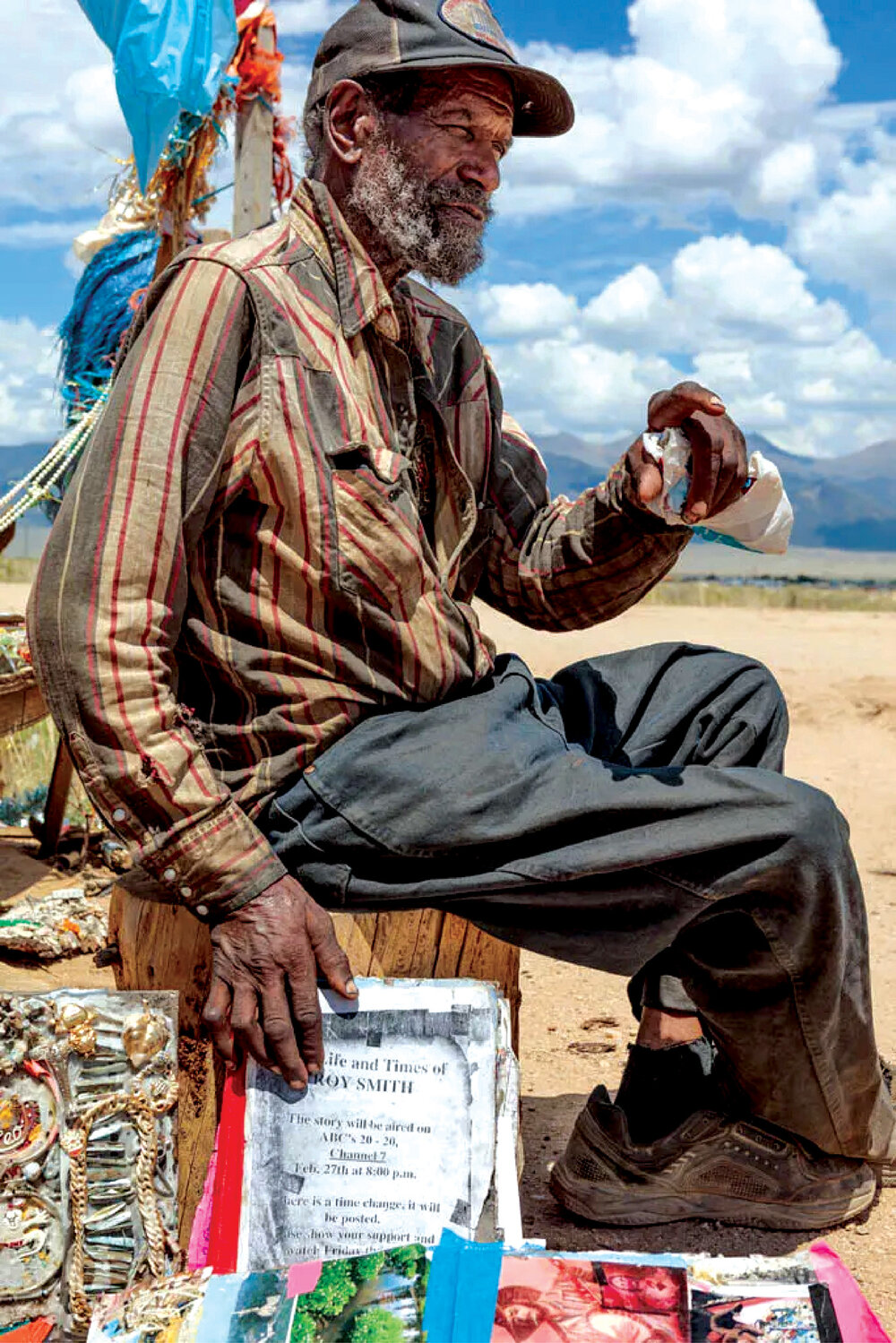
A photo of Roy Smith from 2020 in Saguache, Colorado.

"Ramblin' Roy" Smith, pictured here in 2020, died January 2 at the age of 79.

Roy Smith sued Gilpin County in the 1990s for repeated failure to investigate racially motivated threats against him. Smith alleged inaction by the Gilpin County Sheriff's Office violated his civil rights, and in 1997, a federal judge agreed.
Roy Smith's case against Gilpin County was the subject of a 1998 report on ABC's 20/20.


GILPIN COUNTY — The death of Roy Smith, known to many as “Ramblin’ Roy,” has brought renewed attention to one of the most troubling civil rights cases in Gilpin County’s history.
More than three decades ago, Smith became the plaintiff in a federal lawsuit that accused the Gilpin County Sheriff’s Department of failing to protect him from racially motivated violence. The case ended with a $700,000 settlement, but only after a federal judge described the record as “the most appalling and reprehensible” he had ever seen.
Smith, a Black man living in and around Central City in the late 1980s and early 1990s, reported a long series of alleged attacks. According to court records, those reports included beatings, repeated dog attacks, threats, property damage, and a vehicular assault.
Smith also claimed that many of those reports were dismissed, labeled unfounded, or left without meaningful investigation.
Federal court rejects immunity
In a 1996 ruling in Smith v. Gilpin County, the U.S. District Court for the District of Colorado denied qualified immunity to Gilpin County and several members of the Sheriff’s Department. The ruling allowed Smith’s civil rights claims to proceed, finding sufficient evidence that race may have played a role in how his complaints were handled.
Judge Wiley Y. Daniel ruled that while there is no general constitutional right to police protection, law enforcement officers may not selectively deny protective services based on race without violating the equal protection clause of the Fourteenth Amendment.
The court found that Smith presented enough evidence to raise “genuine issues of material fact” regarding whether racial animus was a contributing factor in the department’s failure to protect him.
Racist language cited as direct evidence
Among the most damaging findings was evidence of racist language used inside the sheriff’s department itself.
Court records show Smith was referred to using a racial slur, including a derogatory nickname stored as an alias in a department computer system. The slur was documented in court filings as “N***** Roy.”
The judge cited this language as direct evidence of racial animus and concluded it could reasonably be interpreted as influencing how Smith’s complaints were treated.
The ruling stressed that Smith did not need to prove race was the sole motivation behind the department’s actions, only that it was one of the motivating factors.
Pattern of inaction
Court testimony described a pattern in which Smith’s complaints were repeatedly closed without resolution, despite medical records, witness accounts, and identifiable leads.
In one notable incident, the court highlighted a reported vehicular assault in which a state trooper documented evidence consistent with Smith’s account. That case was later taken over by the sheriff’s department and ultimately closed for “lack of evidence,” despite physical indicators and a known suspect.
The court also referenced testimony that some incidents were never formally written up, and that evidence was lost or not pursued.
What The Mountain-Ear reported
The details of Smith’s case were documented contemporaneously in The Mountain-Ear during the mid-1990s, as the lawsuit moved through federal court.
On January 9, 1997, Mountain-Ear reporter Jeffrey V. Smith wrote that a federal judge ruled the Gilpin County Sheriff’s Department and several of its members were not immune from civil rights claims, citing what the judge described as “powerful and persuasive” facts showing “violations of clearly established law.”
The article reported that Smith claimed he “did not receive equal treatment as compared to a white,” and that the court found he presented enough evidence to create a “genuine issue of material fact” that race was a motivating factor in the failure to protect him.
According to the same article, Judge Daniel wrote that it was undisputed that the sheriff’s department “declared unfounded or failed to investigate alleged crimes reported by Smith even though it knew that at least some of the incidents were racially motivated.”
The Mountain-Ear further reported testimony that an investigator with the district attorney’s office admitted one investigation was “not competent law enforcement or investigation.”
In a January 23, 1997, Mountain-Ear article titled “Settlement releases sheriff’s department,” Jeffrey V. Smith wrote that an out-of-court settlement between Gilpin County and Roy Smith “calls for a $700,000 payment and other concessions.”
The article reported that the settlement released the sheriff’s office, the current sheriff (Bruce Hartman), and a former sheriff (Rosetta Anderle), as well as two deputies “from any liability, financial or otherwise, from the racial discrimination charges.”
According to the article, county officials said taxpayers were “most likely saved money by the settlement,” arguing that the cost of taking the case to trial would have exceeded the amount paid.
The $700,000 settlement was paid by a Gilpin County liability insurance carrier, not directly by taxpayers.
In addition to the payment, the article reported that Smith would receive “an official written apology from the Sheriff’s Department for several incidents,” which Gilpin County Attorney Jim Petrock described as “sub-standard policing.”
The Mountain-Ear further reported that “over a four-year period, Smith filed approximately 20 reports with the sheriff’s department which alleged crimes ranging in severity from dog bites and vehicular assault to being hung upside down in his own home.”
The article also detailed non-monetary provisions of the settlement, including a request to designate a natural feature in Gilpin County after Smith. One proposal discussed at the time was renaming “Negro Hill” to “Roy Smith Hill.”
Although the name “Negro Hill” remained the official listing on U.S. Geological Survey maps, the article reported it could be renamed on county maps “to show the county’s intentions.”
Removal of a racial name used as an alias for Smith in the sheriff’s department computer system was also included as part of the settlement, though the article noted the name had already been removed weeks earlier.
The article concluded by noting that Smith, a former miner and Russell Gulch resident, had already left the county, telling the court he did so out of “fear for his life.”
Settlement and national attention
Smith’s life later gained national attention in 1998 when ABC’s 20/20, presented by Connie Chung, aired an in-depth segment on Smith’s experience. The broadcast framed the case as a modern civil rights story and questioned how repeated reports of racially motivated violence could go unanswered for years.
In the broadcast, Smith described being attacked more than 20 times over several years. The segment documented repeated beatings, attacks by dogs, and other assaults that left him injured and fearful.
Medical records and interviews presented in the program showed that Smith sought treatment again and again for wounds he said were inflicted during racially motivated attacks.
The program also detailed Smith’s claims that he regularly walked miles into town, often injured and bleeding, to report the incidents to the sheriff’s department and to seek medical care. According to the broadcast, Smith said he stopped at the sheriff’s office before going to the clinic on multiple occasions, believing that reporting the attacks was the only way to protect himself.
In one portion of the interview, Smith demonstrated the measures he said he took to stay alive when he felt law enforcement would not help him.
The program showed how he installed mirrors along his remote access road so he could see if someone was approaching, and described how he sometimes hid at night because he was too afraid to sleep in his cabin.
The 20/20 segment also examined several specific incidents later referenced in court filings, including repeated dog attacks and a reported vehicular assault. The broadcast noted that despite physical injuries, witness statements, and photographic evidence shown during the program, many of Smith’s complaints were closed or left unresolved.
Chung’s report framed Smith’s experience as a civil rights case not only because of the violence itself, but because of what followed. The broadcast questioned how a man could report dozens of assaults over years, show visible injuries, and still be left unprotected.
No criminal charges were ever filed against Smith’s alleged attackers. No members of the sheriff’s department were disciplined as a result of the case.
Smith ultimately left Gilpin County, telling the court he feared for his life and no longer believed local authorities would protect him. He later lived in Saguache, Colorado, where he became known as a folk artist and musician.
Smith’s final years and passing
Roy “Ramblin’ Roy” Smith died Friday, January 2, 2026, at his home in Saguache, according to a family and community announcement. He was 79. Smith passed peacefully, surrounded by friends, after spending his later years in Colorado’s San Luis Valley.
After leaving Gilpin County, Smith settled outside Saguache on a small parcel of land he called “Royville.”
Later profiles described him living in a trailer, collecting discarded objects, and transforming them into folk-art assemblages. Friends in the valley looked out for him, and local artists helped bring his work to public view in Colorado galleries.
A 2018 Colorado Creatives profile traced Smith’s life from Mississippi, where he witnessed racial violence as a child, to his years mining in Gilpin County, and finally to the San Luis Valley. The article noted that Smith had successfully sued Gilpin County over civil rights violations and had found a measure of safety and stability later in life.
Smith’s funeral is scheduled for Saturday, January 10, at Villa Grove Fellowship, with burial to follow at Hillside Cemetery near Saguache. A celebration of life and exhibition of his work is planned for later this year.
An ugly chapter
For Gilpin County, the case remains part of the official historical record. It documents a period in which a Black resident repeatedly sought protection, and a federal court found credible evidence that racial bias influenced the response he received.
It is a history that sits uncomfortably alongside the county’s mining lore and tourist image, but one that cannot be separated from the community’s past—or ignored in its telling.


