
The Town of Nederland Board of Trustees (BOT) and Planning Commission (PC) have, for the majority of 2023, focused on several issues pertaining to the potential development of the Central
This item is available in full to subscribers.
At this time, we ask you to confirm your subscription at www.themtnear.com, to continue accessing the only weekly paper in the Peak to Peak region to cover ALL the news you need! Simply click Confirm my subscription now!.
If you are a digital subscriber with an active, online-only subscription then you already have an account here. Just reset your password if you've not yet logged in to your account on this new site.
Otherwise, click here to view your options for subscribing.
Questions? Call us at 303-810-5409 or email info@themountainear.com.
Please log in to continue |
The Town of Nederland Board of Trustees (BOT) and Planning Commission (PC) have, for the majority of 2023, focused on several issues pertaining to the potential development of the Central Business District (CBD) and the issues within Nederland Municipal Code (NMC) that affect such proposals.
With so many projects citing the Town’s 2013 Comprehensive Plan to leverage approval from Commissioners and Trustees, and with Nederland’s code language seemingly in need of being refreshed, work on an update to the comp plan has been approved and is in progress.
However, as indicated by the approved Strategic Plan for 2023 and 2024, many other “plans” and assessments need to be completed before being properly incorporated into the update of the decade-old document. The development of the update will also include a sub-area plan, centered on the CBD and aimed at setting specific standards for developments which will reflect the wants and needs of the community.
Since January of 2023, the issues of reevaluating and rewriting NMC and of updating existing documents or writing new ones to guide board decisions have been involved with one property owner, Ron Mitchell of Nederland Central Business District Redevelopment LLC (NCBDR), and his proposals that impact many parcels in the CBD.
Over nine months and 15 government meetings the Town has discussed and initiated an emergency moratorium, seen the subsequent retaliation by affected property owner Mitchell, experienced a vote in favor of rezoning a lot that led to a petition, and spawned a protest of said petition that led to a hearing which resulted in the BOT having to repeal their decision.
The central concern which connects all of these issues is that the goals of community-driven planning documents, such as the 2013 Comprehensive Plan and Envision 2030, are not enforceable as dictated by the language in NMC.
The following chronicles the extent of the discussions and actions made so far in 2023 regarding Mitchell’s plans for the CBD and their relation to the Town’s plans to regulate how the CBD should be developed.
Emergency Moratorium
On January 17 the BOT approved Ordinance 835, placing an Emergency Moratorium suspending the processing of land-use applications for properties in the CBD for five weeks.
Ordinance 835 was added to the official agenda on the day of the scheduled meeting and, as the moratorium affected current special review use (SRU) permit applications before the board opted to amend out that provision, concerned property owners, including Mitchell and Christian Vanek, attended the meeting to voice their public comment in opposition.
The moratorium was added to the January 17 meeting agenda by Mayor Billy Giblin and Trustee Tania Corvalan as an action of caution, or a preventive measure, in response to Mitchell’s application for a major lot line consolidation.
The concern was that the application did not include any specific design or construction plans. Therefore, the Town deemed the application “incomplete” and the moratorium was suggested as a means to change NMC with more concrete language that protects Nederland’s identity and vision.
Though some Trustees were opposed, especially to the prospect of labeling the matter an “emergency,” Ordinance 835 passed and the moratorium took effect immediately. Mayor Giblin specified that the changes to zoning code would need to be made expediently so the moratorium could be lifted as quickly as possible.
A lot line consolidation would have allowed Mitchell to more easily tear down structures on his multiple lots to rebuild as a differently zoned and regulated single property. Approving Mitchell’s application would have been the first step towards the complete restructuring of the CBD.
On January 25, Mitchell, representing NCBDR, requested that the PC support the rezoning of 100 East 1st Street, a 1.2 acre property that Mitchell purchased in 2016 and which he has used as a 20-space parking lot for many years. The rezoning would be from High Density Residential (HDR) to CBD.
Mitchell claimed that Boulder County incorrectly zoned the property as HDR in 1982, and that the mistake has cost him in taxes. The lot has remained at 20 spaces because any more added spaces would require Mitchell to submit an application for an SRU permit. His plan for the property is to construct a paid parking lot, which is considered a commercial enterprise and would not require Mitchell to go through the SRU process if the lot is zoned for CBD.
Mitchell explained to the PC how the creation of parking solutions and the construction of a retention pond for stormwater runoff which would mitigate draining issues, are two ways in which his proposal hopes to address quality-of-life concerns expressed in Nederland’s 2013 Comprehensive Plan.
The comp plan was also used against Mitchell’s proposal, as the development of affordable housing was listed within the plan as a priority, which would be practical with the lot zoned for HDR.
During the public comment portion of the meeting, several people, including direct neighbors of the property, were in opposition to what they described as the CBD further encroaching into their neighborhood. As a result, the PC voted to deny Mitchell’s request.
Commissioners felt that the need for housing trumped the need for parking and that the project did not meet the approval of the community. They also agreed that approving property rezoning without adequate deliberation and public feedback would set a dangerous precedent.
They asked Mitchell if he would consider an amendment to the rezoning application that would specify that the land be used for either the construction of a paid parking lot or affordable housing. His response was that he would need time to think about it.
The PC also asked if Mitchell would consider an easement, allowing the Town use of his land at 100 East 1st Street for the construction of a second pedestrian and emergency vehicle bridge that would directly connect Conger Street on the South side to Snyder Street.
In order for the Town of Nederland to own the bridge in this scenario, apart from seeking an easement, the Town could purchase the land from Mitchell directly or they could claim the land due to the Town’s need for emergency planning and evacuation routes.
Mitchell was not open to the idea of an easement when addressed by Commissioners with the idea, but Town Administrator Miranda Fisher noted that during a special meeting to view possible second bridge sites, Mitchell had been open to the discussion.
On the morning of January 27, several businesses in the CBD had notices taped to their doors from Mitchell and NCBDR that read:
“The Town has declared an emergency. During and until that emergency is resolved there will be no parking for you, your employees, or your customers on the parking lots owned by the NCBDR. Fees for violators will be harsh. Cars towed will be charged $600 plus the towing fee and cars immobilized will be charged $600 plus $50 per day until all fees are paid. We regret this situation and hope it can be resolved as soon as possible.
“Do not call us regarding this emergency. Call Town Hall at 303-258-3266. We regret the inconvenience and economic loss this emergency may cause you.”
All of Mitchell’s properties in the CBD where he had allowed parking for years had been fenced off by work crews early in the morning. 100 East 1st Street, 95 East 1st Street, and the corner of East 2nd Street and North Bridge Street were barricaded, affecting businesses from Ubon Thai all down East 1st Street. Derelict vehicles were also towed in to block parking spaces across from Salto and Tin Shed.
Most businesses indicated there was less foot traffic and revenue than had been normal for Saturday mornings, and the parking restriction created road hazards due to the streets being cluttered from improvisational and illegal parking jobs, especially on Snyder Street.
Slowly over the next few weeks, employees of local businesses were allowed to park in Mitchell’s lots, then customers, and eventually the majority of the red fencing came down. But during that time Trustees were hard at work devising a solution to the emergency moratorium, a solution to the changes to NMC, and finding a way to compromise with Mitchell.
On February 7, the BOT began discussing the updates to Town code needed to better reflect the goals of the CBD as outlined in the 2013 Comprehensive Plan and in Envision 2030.
During this discussion they reviewed NMC Article VII, which concerns matters of lot line consolidation, and suggested such improvements as specifying applicants provide architectural and engineering plans, a projected budget and proof of funds, and a projected timeline and deadline of the construction process.
Also during this meeting the BOT heard a presentation from Dr. Bob Widner, partner with the Town of Nederland’s legal firm Widner Juran LLP, concerning community planning and the development of land-use tools. Primarily the conversation was aimed at defining the relationship between a town’s comp plan and town regulations.
The presentation detailed how a comp plan is an adaptable document that defines, as Widner put it, “what a town wants to be when it grows up,” and is born from community input and review by the PC. Widner also explained that regulations are meant to be “tools in the tool box” used to ensure that the Town’s vision, as outlined in the comp plan, is being retained.
Widner concluded that having a solid and updated comp plan is a necessity in order for a municipality to draft intentional ordinances that accurately reflect its goals. He also defended the use of the moratorium as an approved land-use practice that provides municipalities with the time to review and update their comp plan in order to draft more relevant regulations.
To the question of how Nederland can update its comp plan more expediently, Widner suggested the BOT form a team to work on a “sub-area plan,” which allows them to hyper-focus on one specific area of the community.
On Monday, February 13, a special meeting was held at the Nederland Community Library from 3 to 5 p.m. which was intended to allow Mitchell time to present to the Town and to the BOT his redevelopment plans for the CBD in a public setting, though public comment was not permitted.
Mayor Giblin was in attendance, as were Trustees Corvalan, John Mountain, Jesse Seavers, and Nichole Sterling, Mayor Pro-Tem Tom Mahowald, and Administrator Fisher.
Mitchell’s plan for his properties on East 1st Street, which includes having a lot line consolidation approved by Town, involves turning several separate structures into one large structure standing three stories tall, with a resort, planned workforce housing, and retail spaces.
In addition to the central focus of a resort building in the heart of the CBD, Mitchell’s undeveloped lots at 100 East 1st Street and 100 North Jackson Street are also included in his overall plan.
This plan has divided the Town for decades, with many believing that the proposed development could solve Nederland’s many issues, such as parking, sewer and water infrastructure, and affordable housing.
Those opposed to Mitchell’s plan believe the current design would ruin the aesthetic and individuality of the Town. Overall there is a debate over whether this “fear of change” is justified or if it’s just an unfair maligning of Mitchell himself.
Because of the public scrutiny that Mitchell has faced during government meetings, with his character coming into character during many public comments, which Mitchell classified as “harassment,” the meeting on February 13 presumably prohibited public comments so as not to detract or derail from the initial conversation.
Giblin described the Town’s relationship with Mitchell as an ongoing dynamic that has reached an impasse, with the emergency moratorium bringing things to a head. Giblin stated that he was embracing being Mayor at this moment and was hoping that this meeting will act as the beginning of a series of productive conversations where the end result is CBD redevelopment that reflects the wants and needs of Nederland.
“Whatever happens in these two blocks will heavily influence the culture of our town; whatever happens there is a big deal, and maybe how we get there is a bigger deal,” Giblin said.
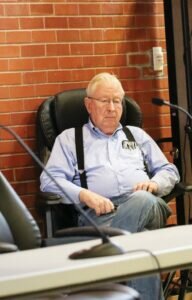
“I am frustrated by the zoning laws and the things that conflict with the ability to get something done, in terms of what the IRS says I can’t do and what the Town says I can’t do,” Mitchell said to the crowd. “We have to do something at some point in time. You have the opportunity to work with me or with somebody else who buys it, it’s that simple.”
Economic vitality, the creation of parking and housing availability, the removal of blight, the resolution of confusing lot lines, becoming more ADA compliant, and the easing of the traffic flow were some of the major positives of Mitchell’s plan listed by the Trustees. It was also noted as positives that the redevelopment would make Nederland attractive to investors and a desirable location for young families.
On the other hand, the negatives of Mitchell’s plan included the possible impacts of construction, the possibility of a single corporate-owned retail center not being affordable for current or future Nederland small business owners, the possible influx of corporate retail and restaurant chains, the potential for the project to go bankrupt and be left unfinished, and the potential for the finished project to fail in securing any tenants.
Mitchell admitted to there being a lot more work to do before some of the Trustees’ bigger concerns could be considered resolved, and he hoped for the conversation to continue forward. Mitchell concluded the meeting by stating that he would “wash his hands of the project” if the Nederland community decides they are against it.
On February 21, Trustees Seavers and Sterling, who had been working since February 7 to form solutions and recommendations concerning the moratorium and on the necessary changes to NMC, led the BOT in a discussion about allowing the moratorium to expire as of February 22 and to form a team to analyze and amend NMC Chapters 16 and 17 by March 21.
The proposed amendments would require any lot line consolidation approved by the PC to be subject to the Planned Unit Development (PUD) process regardless of lot size. The PUD regulatory process forces a developer to meet community goals pertaining to density and land use.
Trustee Eric Coombs-Esmail denied approval of the proposed amendment as it did not affect the lot line consolidation application process, which was the purpose of the analysis that required the emergency moratorium. Coombs-Esmail stated that he felt there was an unnecessary risk to the Town by allowing the moratorium to lapse during the NMC amending process and that doing so would be a “backward process.”
A motion was approved to move the Discussion Item to an Action Item in order for a motion to be made to amend NMC, and to create a team to write new regulations affecting the CBD, to be voted on for support by the PC, while the moratorium would stay in effect until March 22.
Giblin and Trustees Corvalan, Coombs-Esmail, and Mountain voted to extend the moratorium, but with Mahowald, Seavers, and Sterling voted not to extend, and with the motion requiring 6 of 7 Trustee votes to move forward, the motion failed and therefore the moratorium would expire on February 22.
The Petition and the Protest
Swiftly after voting to let the emergency moratorium expire, during the same meeting on February 21 the BOT began their discussion concerning Mitchell’s proposal to rezone 100 East 1st Street from HDR to CBD.
Mitchell expressed wanting to begin the PUD process for all of his lots involved in his redevelopment plan instead of having to go through the process for each property, and also spoke in favor of the lot in question remaining zoned as HDR if the Town were to amend NMC to allow for paid parking to be built on HDR-zoned property.
Before public comment could be heard on this particular discussion item the meeting reached its four-hour deadline and was adjourned. The subject returned as an action item on the BOT’s April 4 agenda.
Over the month of March the BOT and PC dedicated their agendas to amending NMC Chapters 16 and 17 and determining whether to commit to an update of Nederland’s ten year old comp plan.
On March 7, the board gave a nod of four in favor of pursuing a $200,000 Energy/Mineral Impact Assistance Fund (EIAF) grant, administered by the Department of Local Affairs, to fund a full comp plan update, and in favor of hiring a third-party consultant to assist in the drafting process. Applying for the grant required a 50% match from the Town which would come from a supplemental budget.
March 7 was also when Trustees first discussed drafting new code language for NMC concurrently while drafting the comp plan update.
At the same meeting Sterling introduced the concept of the Town Improvement Group for Enhancing Revitalization (TIGER), which consists of three Trustees and seven members from Nederland’s other advisory boards and committees who will “investigate, plan, review, and analyze potential new regulations” for the CBD.
On March 15, bumped up a week from when their meeting was regularly scheduled, the PC voted to recommend to the BOT Ordinance 838, amending NMC Chapters 16 and 17 to include a PUD requirement for lot line consolidation applications that have been recommended by the Commission.
Ordinance 838 was subject to a public hearing and approved unanimously by the BOT on March 21. The ordinance went into effect April 23, just in time for one lot line consolidation application that was set to go before the PC on April 26.
On April 4 the conversation continued over Ordinance 837, authorizing the rezoning of 100 East 1st Street. It was presented as an action item.
Trustees offered Mitchell several proposed compromises pertaining to holding him to his word by ensuring that the property be used for parking, including zoning the property as Neighborhood Commercial, which would require a SRU process to allow for paid parking, and even changing zoning law to allow paid parking to be constructed on HDR zoned property. Mitchell was neither dismissive or accepting of the propositions.
Some Trustees were in favor of the paid parking lot plan for the property, while others felt that the request to rezone did not meet the proper criteria in that there was no proof that the property was originally zoned in error, the area has not significantly changed since it was zoned originally, and that it is not necessary to rezone the property in order to provide paid parking.
A motion to deny the request to rezone 100 East 1st Street from HDR to CBD wasmadeandfailedina4-3vote.A motion to approve the request was made and passed 5 - 2.
On April 26, Mitchell delivered a verbal presentation to the PC on The Amsterdam, his 44,726 square-foot multi-use complex at 100 North Jackson Street, planned for retail space on the first floor and two floors of apartments.
The PC suggested to Mitchell that nearby residents of the Kathmandu plaza and of 150 North Jefferson Street should be approached for their opinions on this construction and on the potential of a rooftop sitting area being above the 35-foot building height limit. Commissioners also noted concern about outdoor furniture on the roof during windy conditions, to which Mitchell noted that the rooftop patio would be for summer use only.
The Amsterdam apartments are planned to be priced based on the cost of construction and on the market value of housing upon time of completion. Mitchell stated that The Amsterdam’s studio and one-bedroom apartments would be considered affordable for the Nederland workforce.
Commissioners asked about the estimated timeline for construction and whether there is a succession of ownership plan in place, in the event of Mitchell’s death. Mitchell estimated two years for construction under “normal circumstances,” which also factors time lost for typical weather conditions, and stated that he and his business partner both have contingencies placed within their agreement should either of them pass away.
Considering the presentation was only an informational item, and that the project has yet to enter the public process, no decisions were made by the PC concerning the Amsterdam project, and no public comment was heard.
On May 5, a referendum petition, signed by 98 members of the Nederland electorate, to reconsider the BOT’s decision to approve rezoning 100 East 1st Street was submitted to the Town. On May 11, Town Clerk Macy Caligaris declared the petition sufficient.
The petition was based on the belief that the proposal did not meet the set criteria, which was a belief shared by some Trustees when the rezoning was originally approved.
On May 16 the BOT chose to wait to see if an official protest of the petition was going to be filed, and on June 6 hearing officer Karen Goldman was appointed by the Board in the event of a protest hearing.
On June 14, a Verified Protest was formally submitted by Mitchell, challenging the petition based on the accusations that each section of the petition was not properly notarized, not properly numbered, not properly signed by the petition circulators, had staples unlawfully removed, that petitioners made misleading remarks on social media, and that handwriting analysis indicated that the address line on petition pages were signed by someone other than the signatory.
The protest hearing was held on June 20 at 9 a.m. at the Nederland Community Center. Mitchell was represented by his legal counsel, Matthew Giacomini and Evan Healey of Springer and Steinberg, P.C. Lindsey Danforth, Kristopher Larsen, Deborah Smiley, and Teresa Robertson were present as the petition circulators and represented themselves.
After hearing the arguments from both sides and after having her clarifying questions answered sufficiently, Goldman called the hearing to a close and indicated that she would require all five business days allotted to reach a final decision.
On the morning of Monday, June 26, Goldman delivered her final determination to Town Clerk Caligaris, which stated that despite “minor technical errors” the referendum petition of Ordinance 837 was sufficient. This determination resulted in the BOT having to decide whether to repeal the ordinance or to hold a public election that would have to be scheduled between July 10 and October 6.
The Repeal
From late June to mid-July the Town was awarded the $100,000 EIAF grant to fund the comp plan update, to which the Town must supply a match of $100,000. An official request for proposal (RFP) was released to obtain a third-party contractor to assist with the update.
In late July to early August the BOT drafted and approved the Nederland Strategic Plan for 2023 to 2024, a planning document with six objectives outlining a focus to “stabilize, plan, and grow revenue,” with each objective to be approached “with a commitment to public engagement and sustainability.”
The third objective of the Strategic Plan is to “promote orderly, sustainable, and resilient development in the Town through thoughtful, engaged, and equitable planning processes.”
Completion of the Comprehensive Plan update is included within the parameters of objective #3. However, it is indicated that the Town’s Housing Needs Assessment, Marketing and Branding Plan, Multimodal Transportation Plan, and Parks, Recreation, Open Space, and Trails Master Plan all need to completed first in order to be properly incorporated into the comp plan.
Specific changes to NMC in relation to the CBD are not listed as priority in the Strategic Plan, though such changes are expected to be made after the drafting of the comp plan update, which the Strategic Plan indicates will not be complete until December 2024.
On September 5, the BOT reviewed proposals from Norris Design and from SE Group about contracting as consultants on the update of Nederland’s 2013 Comprehensive Plan.
SE Group offered expertise in designing ski resorts and specialization in community planning and design with a focus on resort towns, trail and recreation planning, and environmental impact assessments.
Their collaborative efforts are expected to deliver an “artful, informative, and accessible” comp plan through balancing the wants of visitors with the needs of locals, which includes a CBD sub-area plan that focuses on CBD growth through boundary expansion, housing development through code change, and coordinating with the comp plan process to preserve Nederland’s character.
After a motion was made and failed to direct Town staff to complete contract negotiations with Norris Design, a motion was made to contract with SE Group, which passed 4 - 2.
Also during the September 5 meeting Trustees discussed their options, imposed by the result of the protest hearing which found the petition to be sufficient, of either repealing their decision to approve Ordinance 837, which authorized the rezoning of 100 East 1st Street from HDR to CBD, or to hold a special election within 60 to 150 days of August 17.
Mitchell submitted the following letter to the BOT:
“I am aware that the BOT will be reconsidering the approved rezone of my property at 100 First Street at their meeting on September 5, 2023. Despite my original request to rezone 100 First Street, at this time I am requesting the BOT reverse their vote and change the zoning of the property back to HDR.
“The reason I am making this request is because I intend to submit a preliminary PUD application to the PC before the end of the year, which will include all six developments outlined in my Nederland Central Business District Redevelopment plan. In my PUD application, I will be asking the BOT to consider approving paid parking as a use at the 100 First Street site under the HDR zoning.”
Mitchell’s idea to have Trustees consider allowing paid parking on HDR-zoned property was a compromise suggested by Trustee Seavers before the BOT voted to approve the rezoning on April 4, before the petition, the protest, and protest hearing.
Trustees voted four in favor of repealing their approval of Ordinance 837, and on September 19, the board voted to approve Ordinance 848, officially repealing their decision to approve Ordinance 837, returning 100 East 1st Street to its original zoning designation of HDR.
Next steps
The Town of Nederland and its residents have not heard the last of Mitchell and NCBDR’s redevelopment plans for 100 East 1st Street, for 100 North Jackson Street, and for the entire CBD.
On September 10 and September 24, public meetings were held at the Nederland Community Center in order for the public to hear updates on the proposal and to voice their concerns or approval with the designers and with Mitchell himself. Assuredly there are more meetings like these to come.
As the conversation of what redevelopment for Nederland will look like continues in public, in government meetings, and online, Town staff, the BOT, the PC, and the TIGER team will have their hands full as they work diligently to update the Comprehensive Plan and NMC to truly address the community’s concerns pertaining to inevitable changes.


