
Settling into the heart of winter, I find myself once again heading eastward to take in nature’s abundance out on the plains. With much of our own local wildlife hunkered down and enduring more
This item is available in full to subscribers.
At this time, we ask you to confirm your subscription at www.themtnear.com, to continue accessing the only weekly paper in the Peak to Peak region to cover ALL the news you need! Simply click Confirm my subscription now!.
If you are a digital subscriber with an active, online-only subscription then you already have an account here. Just reset your password if you've not yet logged in to your account on this new site.
Otherwise, click here to view your options for subscribing.
Questions? Call us at 303-810-5409 or email info@themountainear.com.
Please log in to continue |
Settling into the heart of winter, I find myself once again heading eastward to take in nature’s abundance out on the plains. With much of our own local wildlife hunkered down and enduring more challenging conditions, the vast grasslands below, unfettered by lingering snows, provide ample opportunities for observing our natural world in (at least slightly) more amiable conditions. With summer conditions hearkening my soul to return to its home in the high country, winter brings me another equal joy, that of observing the amazing raptors that inspired much of my own early endeavors with wildlife photography.
While we enjoy a wide variety of birds of prey throughout Colorado, this week looks at one of the smallest, but no less fierce than their larger cousins: the American Kestrel. The kestrel is the smallest member of the falcon family, at 8-12 inches in length, a 20-24 inch wing span, and weighing in at a whopping 3-6 ounces. As a rough comparison, they fall at a size somewhere between a robin and a crow.
Kestrels enjoy a wide variety of prey to feed on, which explains their widespread abundance throughout much of North America all year long. A mainstay of their diet is small rodents, which the plains provide a steady diet of.
It is said about their European relatives that a lack of voles generally displays an equal lack of kestrels. As we know well, the vole is found in quite healthy numbers here in Colorado, and subsequently we see an equal abundance of these tiny yet mighty lords of the air. Along with the abundant vole and small rodents, other prey includes lizards and insects, as well as small birds.
These stunning and vibrantly colored falcons can usually be found perched on power lines lining the highways and byways of the prairie, as these prominences provide a high view from which to rest while seeking prey in the tall grasses below. While trees also suffice, their lack of abundance in the plains explains the kestrels’ choice of the man-made perch from which to plan an attack. Fences are often another common roost, and due to the birds’ diminutive size, they also may be seen atop mullein stalks: these stalks are also ample enough in height to distance them from their prey during a hunt.
Once prey on the ground is spotted, the bird will launch, but will often take advantage of breezes if available and hover above their prey. Facing into the wind, they will flap their wings and use their spread tail to maintain their place over the target until ready to dive into an attack.
As mentioned above, other prey are smaller birds, and with these targets they take a different approach more like their larger falcon cousins, relying on incredible speed. Reaching vertical speeds of up to 40 mph, they can quickly overtake a passerine, using its tiny, curved beak to sever a spinal column in mid-flight.
This hunting of birds has historically placed them among the ranks of other raptors used in falconry - the use of aerial predators to hunt. Their size and speed make them quite an enjoyable addition to a falconer’s arsenal. While their prey may not serve for human consumption, their ferocity and agility provide ample “sustenance” to the sport: hunting sparrows, starlings, and other smaller birds.
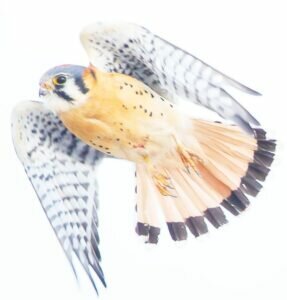
The Kestrel in this week’s image was found atop a power line while out and about on a morning “raptor ride” through the plains. A cloudy day made for a “high key” approach to the photography (over-exposed to capture the details and color, making for the white background). And while a slower shutter speed was needed, it was just fast enough to capture the details of the head, body, and feet, the last of which are the strongest talons for its size of any raptor used in falconry. Quite a beautiful display to behold as it headed off to find its next meal, leaving me to bid farewell and give thanks before continuing on my own hunt for exquisite (birds of) prey.
Sources for this article include: https:// www.allaboutbirds.org/ guide/American_ Kestrel/id, https:// www.themodernapprentice.com/ AMkestrel.htm, and https://www.nhnature.org/visit/animal_ info_ sheets/kestrel.php#:~:text= American%20Kestrels%20can%20 fly%20at,clocked%20at%20 over%20200%20mph!.
For additional information about James DeWalt Photography, check out https:// jamesdewaltphotography.com.


