
A few weeks ago, I wrote an article regarding the “salad days” of summer in the high country. This week I decided to take a look at a slightly different variation of the theme.
This summer
This item is available in full to subscribers.
At this time, we ask you to confirm your subscription at www.themtnear.com, to continue accessing the only weekly paper in the Peak to Peak region to cover ALL the news you need! Simply click Confirm my subscription now!.
If you are a digital subscriber with an active, online-only subscription then you already have an account here. Just reset your password if you've not yet logged in to your account on this new site.
Otherwise, click here to view your options for subscribing.
Questions? Call us at 303-810-5409 or email info@themountainear.com.
Please log in to continue |
A few weeks ago, I wrote an article regarding the “salad days” of summer in the high country. This week I decided to take a look at a slightly different variation of the theme.
This summer has found us with a couple of troublesome youngsters of the ursine persuasion, and as I was recently digging into my vaults for some photos for the Nederland 150 celebration, I came across some images from a summer afternoon 14 years ago that inspired this week’s writing.
Living much of their year in slumber, or at least with significantly less motivation, these neighbors of ours spend most of their summer and fall life either eating or on the hunt for a meal. With a need to build up enough fat reserves to last them through a long winter, they will take any opportunity to dine presented to them. This opportunism often has them frequenting our yards and homes in search of whatever food they might be able to get their paws into.
It is doubtful that we have more bears than usual this year. It’s likely that we are hearing about them more often due to two main factors. First, social media and the more frequent use of game cameras and security cameras puts their usually clandestine presence in front of us a lot more often, thus leading us to a (false) conclusion that because we are seeing them more, there must be more of them.
The second reason is likely due to an influx of new human residents who simply aren’t aware of the protocols absolutely necessary to deter bears from having an interest in our homes and potential food sources.
We have been seeing many reports this year of young bears coming to homes in the daytime, which leads me to my first point of behavior.
It is somewhat of a myth that bears are nocturnal in their activities. Bears in the wild are awake during most of the day (with a nap or two thrown in), and sleep at night. Bears that live around humans tend to be more nocturnal simply to avoid contact with us.
In the case of youngsters, as with our moose, the kids get sent out on their own at a young age, and not fully “seasoned” in their experience with us, and tend to linger around the humans simply due to the perceived ease of a meal. Young bears simply haven’t learned the lessons necessary to keep them safe from human interactions, and thus are merely following in the genetic footsteps of the generations before them: simply “going with their gut” in their opportunistic attitudes towards dining.
It is incumbent upon us humans to make sure we help to “teach” these youngsters (as the saying goes, it takes a village…) how to behave properly. This means not leaving any opportunity for them to have access to food.
Trash cans must be kept inside solidly closed doors, whether in a garage, a shed, or somewhere in a house that is not easily accessible. While having a “bear-proof” trash can might help, if it’s left outside it will not stop a curious bear of any age from repeatedly stopping by for another go at attempting to get to the tasty treats inside.
All food must be removed from cars that stay parked outside. You do not want to see first-hand what a bear of any size will do to the inside of a car once it is done dining and can’t figure out how to get back out.
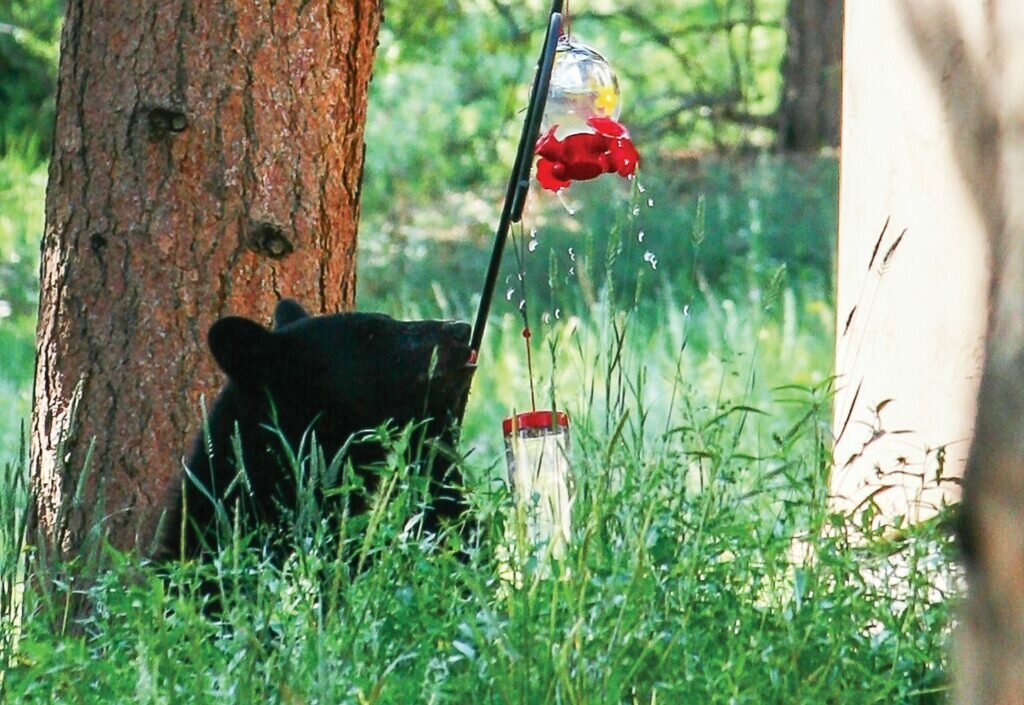
Also, bird feeders of all kinds present issues if bears get to know their location. As seen in this week’s image, this young bear was found exploring the Sunnyside neighborhood on an August afternoon in 2012, and had very easy access to a couple of hummingbird feeders left on a stand that was only about waist high from the ground. Like any child, the sweet treat was FAR too irresistible, and the source was FAR too easy to get at.
Outside of these basic protocols that remove most of any bear’s temptations, solid hazing techniques help to deter their interests in returning to a possible food source. This includes loud noises (typically, a hearty banging together of pots and pans works wonders) along with yelling, and while approaching wildlife is never a good idea, in this case it can sometimes help encourage a bear to leave.
While that cute little teddy clamoring about on your deck might just be the most adorable thing you’ve ever seen and need photos of for the family out east, you won’t be very happy about that same bear when it comes back a whole lot larger.
Please know that while this statement is common, it rings incredibly true: a fed bear (intentionally or otherwise) is a dead bear. Relocating techniques are mostly ineffective, as the perp can often return to the problem area, or face an early demise by being killed by an elder bear who is not happy about the new competition for its territory. A “humanized” bear with multiple strikes by CPW (Colorado Parks and Wildlife) officials will be euthanized without question.
As with any wildlife, we need to share space with them responsibly. A bear with easy access to food is not the problem; it is the human who provides that access that is the problem.
For additional information about James DeWalt Photography, check out https://jamesdewaltphotography.com.


