
Cross-boundary Collaboration is a popular term that describes groups working together beyond their own organizational limits to solve complex problems.
The St. Vrain Forest Health Partnership
This item is available in full to subscribers.
At this time, we ask you to confirm your subscription at www.themtnear.com, to continue accessing the only weekly paper in the Peak to Peak region to cover ALL the news you need! Simply click Confirm my subscription now!.
If you are a digital subscriber with an active, online-only subscription then you already have an account here. Just reset your password if you've not yet logged in to your account on this new site.
Otherwise, click here to view your options for subscribing.
Questions? Call us at 303-810-5409 or email info@themountainear.com.
Please log in to continue |
Cross-boundary Collaboration is a popular term that describes groups working together beyond their own organizational limits to solve complex problems.
The St. Vrain Forest Health Partnership (SVFHP) is a coalition of governmental, non-profit, and private organizations engaging in cross-boundary collaboration to increase the fire resiliency of the St. Vrain watershed for the benefit of forest ecosystems, water quality, and affected communities.
SVFHP held their 2024 All Hands meeting on July 31, 2024, at the Highlands Presbyterian Camp and Retreat Center near Allenspark. The meeting was an opportunity for a number of the organizations in the partnership to come together and show the results of their collaborative projects and highlight future activities by the varying organizations.
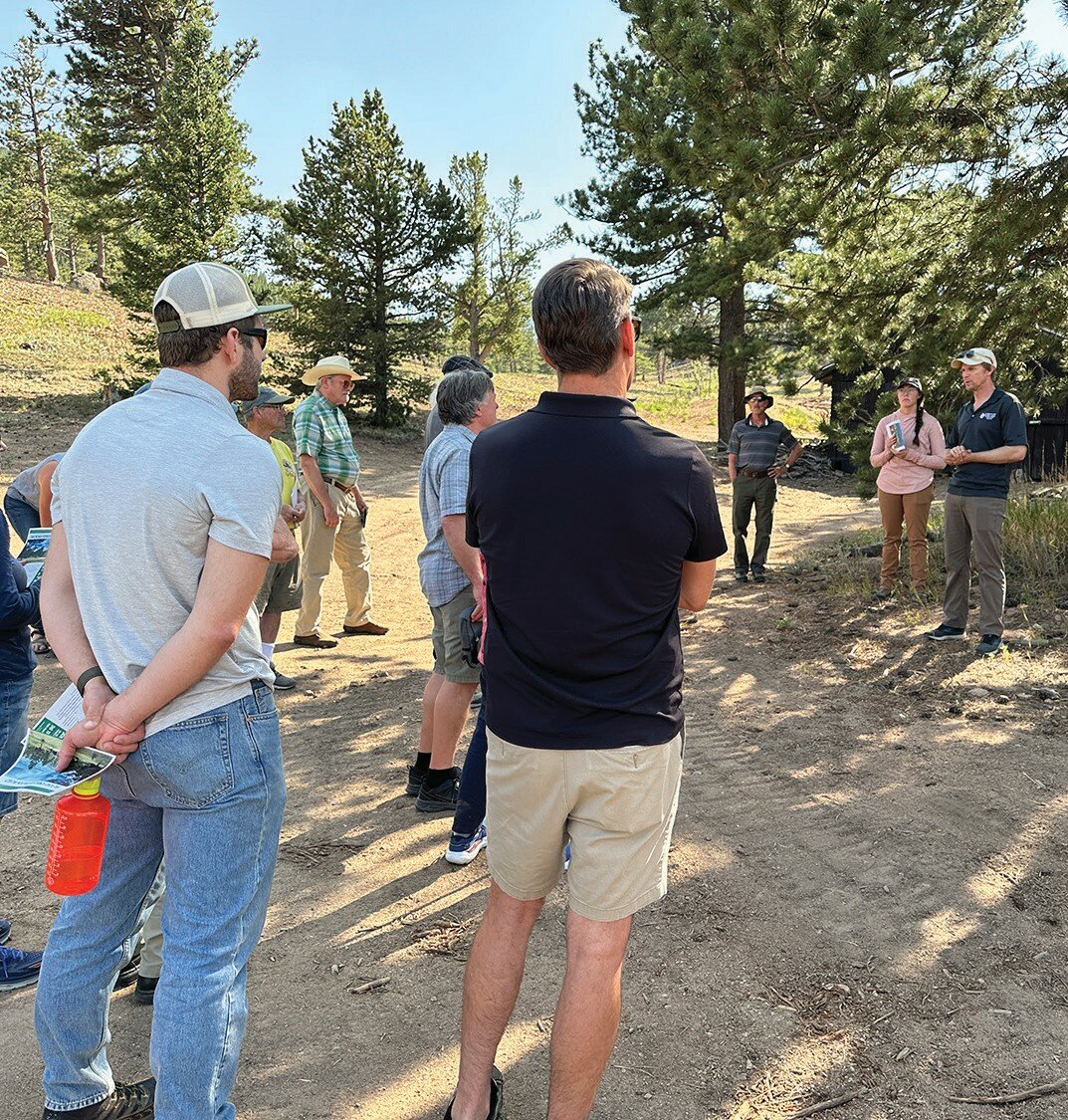
The meeting was structured in three parts. The first was a tour of Boulder Valley and Longmont Conservation Districts’ forestry project at Highlands Camp. Meeting attendees were given a walking tour of the mitigated land south of the camp. The tour leaders were the District Director of the Boulder Valley & Longmont Conservation Districts, Rob Walker, and the District Conservationist Jessica Jackman.
The camp, along with neighboring property owners, came together to mitigate about 100 acres using a combination of hand and mechanical thinning. The goal of the project was to reduce the risk of wildfire severity and tree crowning, increasing forest resiliency, and building survivability.
The initial phase of the project has been completed and the tour was able to see the landscape post-mitigation. Walker explained that the thinning had reduced stand density from 200 trees per acre to about 50. The predominant tree in the area is ponderosa and the landscape is a return to open meadows where a crown fire would have to go to the ground to continue.
Jackman said that the treated acreage would be monitored for three years for noxious plants and windthrow. There is a threat of non-native noxious plants taking over a landscape that has recently been treated. There are several treatment methods available depending on the noxious plants that invade. Jackman singled out Canadian Thistle and Cheatgrass as the most likely noxious plants to appear.
Walker said that 30 acres of the 100 will be treated with Mycelium from Boulder Mushroom. This will speed up the decomposition of cellulose by spraying the chips on the ground with a native mushroom mixture. There will be a good comparison with the 70 acres that will not be treated.
The second part of the meeting was a series of flash presentations by the different participating organizations. Speakers from each talked about the purpose of their organizations, past projects that they had been involved with, and potential future projects or problems that they anticipated dealing with. The presentations lasted from three to ten minutes, with open-ended questions and answers.
The agencies and organizations making presentations included The Watershed Center, Boulder County Wildfire Partners, Boulder County Parks and Open Space, United States Forest Service, Colorado State Forest Service, Boulder Valley and Longmont Conservation Districts, City of Longmont, Allenspark Fire Protection District, Big Elk Volunteer Fire District, Cal-Wood Education Center, and St. Vrain and Left Hand Water Conservancy District.
Chiara Forrester from The Watershed Center acted as the moderator. The Watershed Center (www.watershed. center) acts as the coordination point for the SVFHP efforts.
One completed project is the Jamestown Fire Mitigation Project, which treated 43 private properties in Jamestown, which is surrounded by national forests. In collaborative fashion, the project involved the Watershed Center, Boulder Valley and Longmont Conservation Districts (bouldervalley-longmontcd.colorado. gov) and Lefthand Fire Protection District (lefthandfire.org).
Meg Halford from Wildfire Partners spoke about a new rebate program offered to help homeowners mitigate their private property. Wildfire Partners also offers free property inspections to help with identifying mitigation and home hardening opportunities.
The last part of the meeting encouraged attendees to go around to the tables of participating organizations and speak with the presenters about individual topics of concern.
The SVFHP All Hands meeting showed how landscape management in the St. Vrain Basin is a coordinated effort that crosses organizational boundaries and is focused on using fire science and adaptive management techniques to create fire resilient forests and communities.
The Watershed Center maintains the website for SVFHP at watershed.center/project/svfhp. The other organizations can be found on the Internet by using their name as the web search term.


