
Sister Rosetta Tharpe, the Godmother of Rock ‘n’ Roll, influenced Ella Fitzgerald, Aretha Franklin, Johnny Cash, Little Richard, Elvis Presley, Jerry Lee Lewis, Eric Clapton, Jeff Beck, and
This item is available in full to subscribers.
At this time, we ask you to confirm your subscription at www.themtnear.com, to continue accessing the only weekly paper in the Peak to Peak region to cover ALL the news you need! Simply click Confirm my subscription now!.
If you are a digital subscriber with an active, online-only subscription then you already have an account here. Just reset your password if you've not yet logged in to your account on this new site.
Otherwise, click here to view your options for subscribing.
Questions? Call us at 303-810-5409 or email info@themountainear.com.
Please log in to continue |
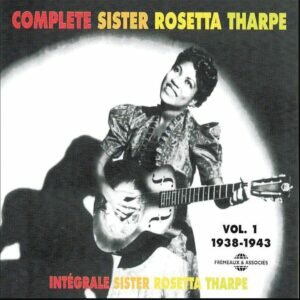
Sister Rosetta Tharpe, the Godmother of Rock ‘n’ Roll, influenced Ella Fitzgerald, Aretha Franklin, Johnny Cash, Little Richard, Elvis Presley, Jerry Lee Lewis, Eric Clapton, Jeff Beck, and even Chuck Berry, The Godfather of Rock ‘n’ Roll.
In the 1930s nobody had ever heard a woman…or a man…play the guitar the way that Sister Rosetta Tharpe did. She could shred and her impressive and energized melodic lines were tastefully enhanced when she got her hands on her Gibson Les Paul Custom electric and started playing with distortion. This sound combined with her incredible voice and presence would mark her as one of the pioneers of Rock ‘n’ Roll.
Tharpe’s story begins with her mother. Katie Bell was an Evangelist and would sing and play mandolin to anyone who’d hear it, spreading the good word of the Pentecostal church. Bell lived for God and she instilled that conviction in her daughter. Tharpe took to singing gospel and playing just like her mother. As Tharpe became famous, her mother stuck by her side.
Tharpe’s strong faith and unique talents made her presence mesmerizing. In the 2011 documentary “The Godmother of Rock ‘n’ Roll - Sister Rosetta Tharpe” produced by Mick Csaky, shows Helen Henderson, a church goer of the Church of God and Christ in Philadelphia, when she was 10 years old in the 1930s and heard Tharpe sing in church. Henderson recalls, “She had the most beautiful voice, and the way she could speak to you. It made you feel….different. You knew something was going on even if you didn’t understand really what it was.”
The pastor of that church, Pastor Robert Hargrove, said that Tharpe’s freedom of expression “woke up the congregation…it focused them on something that was on the inside that they had never gave expression to.”
In 1944 she released her #1 hit song titled “Strange Things Happening Every Day.” This song is said to be a reflection of Tharpe’s experience as a black woman post World War . when the US was proclaiming freedom for “everybody.” The irony saddened her as segregation was a regular part of her tours, restricting what hotels she could stay in and what restaurants she could eat in.
“Strange things Happening Everyday” became one of the first Rock ‘n’ Roll records.
At the age of 49, in 1964 she performed in Manchester for a Folk/ Blues/Gospel revival TV show at an old train station. Her songs “Didn’t it Rain” and “This Train” were perfectly suited for the occasion. It was an iconic performance and can be viewed on YouTube.
Though Sister Rosetta Tharpe passed away too soon, in 1973, she is continually honored and revered. In 2008 the Governor of Pennsylvania declared January 11 Sister Rosetta Tharpe day. In 2018 Brittany Howard of Alabama Shakes inducted Sister Rosetta into the Rock ‘n’ Roll hall of Fame stating that, “It’s been long overdue” before covering “That’s All” in Tharpe’s style.
Soak your soul in Sister Rosetta Tharpe. Her music is widely available on YouTube, Spotify, Amazon, and Apple Music.


