
Springtime is the season of renewal, with trees budding new growth, annual flowers beginning to sprout from the newly thawed ground, and the elusive human recluse emerging from the cabin after a
This item is available in full to subscribers.
At this time, we ask you to confirm your subscription at www.themtnear.com, to continue accessing the only weekly paper in the Peak to Peak region to cover ALL the news you need! Simply click Confirm my subscription now!.
If you are a digital subscriber with an active, online-only subscription then you already have an account here. Just reset your password if you've not yet logged in to your account on this new site.
Otherwise, click here to view your options for subscribing.
Questions? Call us at 303-810-5409 or email info@themountainear.com.
Please log in to continue |
Springtime is the season of renewal, with trees budding new growth, annual flowers beginning to sprout from the newly thawed ground, and the elusive human recluse emerging from the cabin after a long winter with a stretch and a yawn in the warm sun before heading out for a beer and a catching-up on the winter’s gossip.
It is also the season of the new, with much of the animal kingdom carrying on their lineage and bringing forth the next generation. This week we look at one of our common yet very elusive winged neighbors, the Great Horned Owl, as this year’s fledglings are currently only a few weeks to a month old.
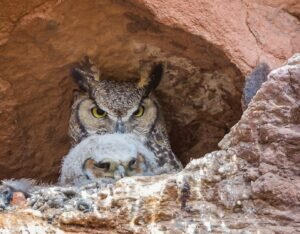
Great Horned Owls are generally monogamous in their partnerships, and while they will share a territory with their partner, outside of the breeding period they typically roost separately. January and early February bring their mating season and the subsequent search for an ideal nest. Interestingly, they do not build their own, but prefer to use those of squirrels, hawks, or crows. While trees are most commonly used, the owls are not averse to using a protected niche in a cliff face, as seen in this week’s image.
Gestation takes a few weeks, after which the female will lay two or three eggs (occasionally as many as five). The incubation period is about 30-35 days, with the female solely taking on the role of keeping the eggs warm, leaving the male to hunt and make regular food deliveries. These owls have the most diverse appetite of any raptor in North America, dining on everything from mice and large insects to rabbits, squirrels and possums, and even larger birds such as ducks, geese and even other raptors.
In defense of their territory, they may even kill one of their own species, but most likely not in a hunting capacity. It bears noting that while they may well hunt a small pet such as a cat or dog, they can only carry about nine pounds, and, since they live where there is an abundance of other smaller food sources, pet hunting is rare in this area.
Once hatched, nestlings take seven to eight weeks to grow, slowly but surely losing their fine, lighter-colored down (floof!) and growing proper feathers for flight. Once the young are large enough, the adults will take turns on the hunt, with one always near the nest for protection.
As the littles reach ideal maturity, they will begin to gain a bit of bravery, making moves further from the nest until the fateful day when they take their first leap and try out their new wings. This typically does not result in an actual flight for their first try, but teaches them the necessary bravery to do so.
Much of this early life is spent walking around, strengthening their legs for later hunting needs. Even once they do gain their first flight, their parents will continue to provide regular food deliveries until the young ones have learned the art of the hunt. It is not until late summer, or even fall, that they finally head out into the world on their own. Occasionally a young one may be seen begging for food from the adults as late as October, much like the occasional human child not yet ready to head into the wide world.
It bears noting that, as with most birds, one should always keep a good distance from an active nest with young. While some owls are quite accustomed to human presence and don’t seem to mind much, many species can become very stressed under pressure (purposeful approach). With Great Horned Owls, another factor is involved: their fierce defense of territory, as they have been known to attack humans whom they felt threatening.
In the case of this photo, I was about 50-60 yards or more away and cropped the image tightly to gain the “up-close” view. Mama had chosen this enclave near a very heavily trafficked hiking trail, and while high on the sandstone cliff, she still seemed wary of the humans, as noted by the wide-eyed, intent stare. The little one, however, seemed to be quite enjoying watching the many silly two-legged land creatures going up and down the hill in their front yard.
Information from this article came from https://www.allaboutbirds.org/guide/Great_ Horned_ Owl/overview and https://www.audubon.org/fieldguide/bird/great-horned-owl.
For additional information about James DeWalt Photography, check out https:// jamesdewaltphotography.com.


