
The original settlers of Dayton formed it as mostly a farming community producing hay, potatoes, strawberries, and grapes. They proposed to prohibit liquor traffic within its borders and had the
This item is available in full to subscribers.
At this time, we ask you to confirm your subscription at www.themtnear.com, to continue accessing the only weekly paper in the Peak to Peak region to cover ALL the news you need! Simply click Confirm my subscription now!.
If you are a digital subscriber with an active, online-only subscription then you already have an account here. Just reset your password if you've not yet logged in to your account on this new site.
Otherwise, click here to view your options for subscribing.
Questions? Call us at 303-810-5409 or email info@themountainear.com.
Please log in to continue |
The original settlers of Dayton formed it as mostly a farming community producing hay, potatoes, strawberries, and grapes. They proposed to prohibit liquor traffic within its borders and had the honor of founding a mountain town on temperance principles even though the eldest children were “said not yet hardly up to the a-b-c age (Caribou Post, August 19, 1871).”
Grace Greenwood visited Caribou in 1871, staying at the Planter House. She wrote: “Mining life here is sober and laborers and law abiding–we at least saw no gambling, no drunkenness, no rudeness, no idleness.” She was shown the Caribou mine by Ulysses Pugh, an old prospector, miner, bear and elk hunter (whose wife is buried at the Caribou Cemetery) and Samual Conger a “miner and Indian hunter (Caribou Post, October 7, 1871).”
The temperance movement at Nederland and Caribou may have been a response to Denver’s reputation as a whiskey town. “There is more drinking and gambling here in one day than in Kansas City in six, in fact one-half of the population do nothing else but drink whiskey and play cards,” wrote G. N. Woodward on April 3, 1859. “Inhabitants are Indians, Mexicans, and white people – about equally divided – all hard cases. Drinking and fighting all the while, someone killed nearly every week – now and then one hung,” reported an unsigned letter on April 17, 1859.
It was not until 1871, when the Boulder Canyon Wagon Road was built as a one-way toll road with 33 bridges, that Brownsville was connected to Boulder. In 1871 a post office was established, and Brownsville was renamed Middle Boulder after the creek that ran through town. Middle Boulder had a population of 200.
Walter Smith of the Colorado Stage Company ran a stage from Erie to Caribou that stopped at Boulder City, Monday, Wednesday, and Friday, returning the next day. Lee Smith was the driver, and it cost $8.00. A six-horse coach to Central City left Caribou at 9:30 on Tuesday, Thursday, and Saturday for $2.50 and arrived in Central City at 3:00 or 8:00 p.m. (Caribou Post, July 22, 1871)
The Crevice of shipping ore at the bottom of the Caribou shaft, at 200 feet deep, “is five feet thick and improving per fathom of depth…. The vein is so true and perfect, the ore so continuous and so easily mined that the expenses amount to, but a small percent of the gross amount realized on any market (Caribou Post, September 9, 1871).”
Forty-five miners worked at the Caribou mine and were paid $3.25 per day. At most mines, sinking the shaft does not make a profit, but the Caribou shaft paid for itself. At 212 feet deep the mine had three levels and the vein was seven feet wide (Caribou Post, October 7, 1871).
By October 7, 1871, two more hotels had been built in Middle Boulder. Mr. Pickel built “the nicest stable we have seen in the county (Caribou Post, November 11, 1871).”
In December the wind blew all the snow away and a fire started on the hillside opposite Caribou hill, but it was put out before it reached the town (Caribou Post, December 16, 1871).
During the winter, and depending on snow level, the wheels on wagons were quickly fixed with sled runners for the trip to Middle Boulder. The road in and out of Middle Boulder was drifted in with snow. Many families and prospectors from Caribou decided to spend the winter at the lower altitudes of Middle Boulder during the “season of wind and snow.” In 1871, the Christmas ball and the New Year’s Eve party with the Caribou band was held at Brown’s hotel in Middle Boulder.
“There is less prospecting, fewer idlers than during the summer, but more men working for wages, more legitimate mining and consequently more money made. Shaft houses continue to operate so there is no decrease of business in Grand Island (Caribou Post, December 23, 1971).”
A.D. Breed, and D.B. Cutter decided to locate their state-of-the-art reduction mill (with 15 stamps, and five floors) close to the abundant timber and water in Middle Boulder (Nederland), away from the weather at Caribou. This decision was contrary to the typical practices of the time, when the mill was usually built adjacent to the mine. Their choice allowed the Caribou Mill in Middle Boulder to become the largest and most successful silver mill in the Colorado Territory by 1872. The Breed and Cutter Mill in Middle Boulder opened on January 27, 1872. Five teams of horses would haul two tons per day down from the mine at great expense due to the snow.
“An immense body of snow” covered most of the miner’s cabins in Middle Boulder, leaving the miners to shovel out the stove pipes (Caribou Post, February 10, 1872).
“The Breed and Cutter mill was producing 100 pounds of silver every 24 hours, and about 1 ton of silver every 20 days and it expected to produce 100 tons of silver per year (Caribou Post, February 17, 1872).”
“Browns Ranch in Middle Boulder, which started as a boarding house 6 months ago was expanded into a hotel. Major Buttles who constructed and maintained the road down Boulder Canyon built a hotel in Middle Boulder (Caribou Post, February 26, 1872).
That winter everything in Caribou was buried in snow and access was by sleigh. Prospecting ground to a halt but the town, businesses, and most mines were still open. “In the ore sorting room at the Caribou mine shaft house, a fire is blazing in a big open fireplace, after the style of an old-time New England farmhouse (Caribou Post, March 20, 1872).”
Major Buttles and his lady ran the Middle Boulder House hotel in Middle Boulder. On May 4, 1872, they sold the hotel to the long-time cook, Stephen Green. Oscar Savery and Green agreed to run the hotel and Oscar married Mary Goyer. “The snow is 6 feet deep in Caribou and the town was threatened by an avalanche from Caribou Hill (Caribou Post, May 4, 1872).”
Middle Boulder raised $2500 to build a schoolhouse and a new sawmill in Middle Boulder was opened by Mr. Walling (Caribou Post, May 18, 1872).
Five teams of wagons hauled 20 tons of ore per day down to Middle Boulder from Caribou at “great expense” due to the snow drifts. Depending on snow levels, ore wagons were fixed with removable sled runners. The Breed and Cutter mill in Middle Boulder shut down for a few days while the road to Caribou was shoveled out and a new road to Caribou was begun on the north side of Coon Trail Creek. (Caribou Post, May 18, 1872). The mill hired 40 men to clear the road to Middle Boulder. In March, the mill treated 30 to 40 tons of silver ore from Caribou per day, and the mill produced 6,000 ounces of silver in four bars (Caribou Post, March 30, 1872).
Thirty bricks of silver poured at the Breed and Cutter Mill in Middle Boulder paved the front of the Teller House in Central City for the visit of Ulysses S. Grant in 1873. The silver bars weighed from 725 to 1306 ounces each, and varied in value from $15,000 to $27,000. Helped by the international publicity generated by Grant’s visit to Central city, Abel Breed was able to sell the Caribou mine and mill in the spring of 1873, to “The Mining Company Nederland” for $3,000,000. (Although the actual cash payment was less than one half of that sum, Breed walked away with $1,000,000.)
It was said that there was a “large quantity of good ore” left in the mine when the agents from Holland examined it before the sale. But by the time the mine was turned over, Breed had stripped the mine of most of the richest ore. Between 70 and 90 men were employed at the Caribou mine, and even though it had some of its most productive years in 1874 ($130,000) and 1875 ($204,703), conflict, contentions, mismanagement, and debts reduced production to $25,000 by 1876. The mine closed in November of 1876. The Caribou mine was sold at tax sale in October of 1876 to Jerome B. Chaffee for $70,100. At this point the mine was 470 feet deep.
By 1889, only seven families lived in Nederland. Unfortunately, three of Nathan Brown’s four children died of diphtheria in a single week and his wife of 20 years, Catherine, filed for a divorce soon afterwards. After trouble with bill collectors, and repeated brushes with the law for disturbing the peace, Nathan W. Brown eventually lost his property and moved to Boulder vowing never to return. Nathan Brown died in Boulder and was buried with his wife Virginia and three-year-old son Roy in the Nederland Cemetery in 1889. In 1895, Nederland’s original cemetery’s 29 residents were removed to a new location northwest of town to make room for the expansion of St. Rita’s church.
In 1891, John Kemp founded Happy Valley Camp (later Eldora), and in 1892 many gold-silver telluride veins were discovered in the nearby hills south and west of town. In 1892, Nederland’s population was 100, and Happy Valley camp had two log cabins and a population of 10.
In February 1897, Happy Valley Camp was renamed Eldorado, and the post office was established. After the postmistress found out that mail was being routed to Eldorado, California, the town’s name was shortened to Eldora. The new town boasted five saloons, a bank, a newspaper, and a red light district across the stream from town that was referred to as “Monte Carlo.” It is said that five or six houses were started every day during the summer of 1897. Nederland’s population was 200 and Eldora’s population was 1300.
Things started to disintegrate in 1899, when the Enterprise mill could not successfully treat the gold-telluride ore. When the mill manager, Neil Bailey, missed a payday, the employees set his house on fire and fatally shot him in the arm. No amount of promotion could cover up the fact that the mines near Eldora had not produced significant amounts of gold, silver ,or copper. Many of the Eldora mines burned in 1901, but the main part of town was spared. Only one saloon was left in Eldora by 1904. By the time the railroad finally reached Eldora in 1905 many of the mines were closed. In 1900, Nederland’s population was 200, and Caribou’s population was 44.
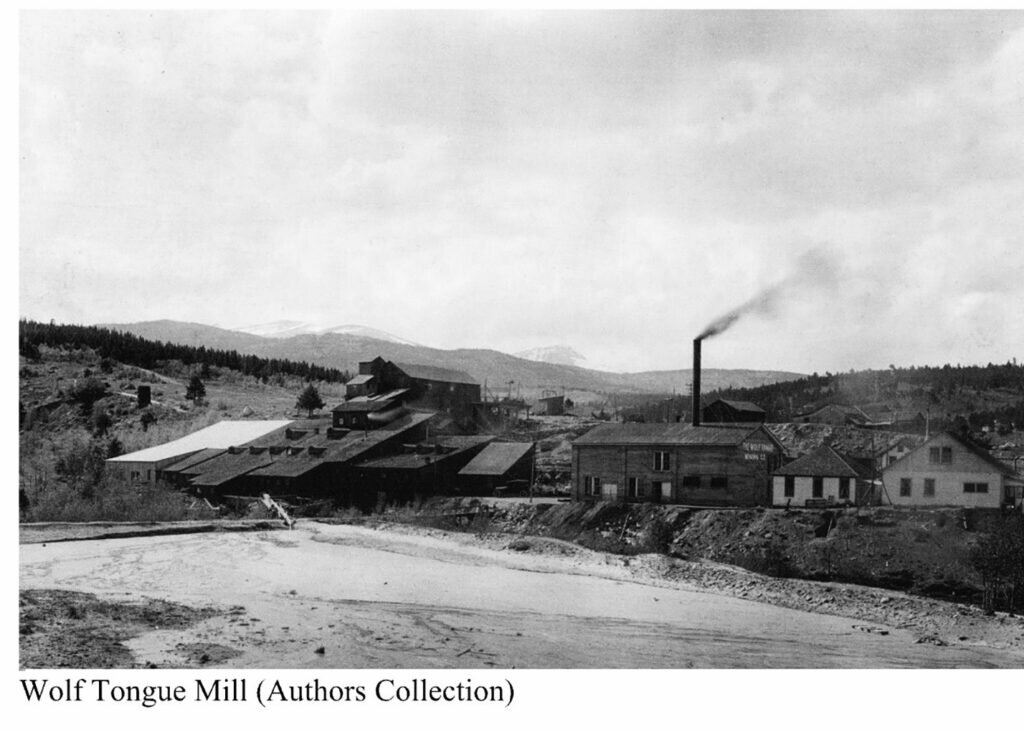
Gold and silver prospecting began in the Nederland area around 1859, but the heavy black mineral (called barren silver, heavy iron, and black iron by the miners) was not recognized as tungsten ore, or ferberite (FeWO3), until 1900 by H.H. Wanamaker and Samual Conger. The Wolftongue Mining Company was named after a combination of the words tungsten and wolframite (MnWO4), a common tungsten mineral rarely found in Nederland.
Nederland became by far the leading producer of tungsten in the United States from 1900-1918. The Nederland Tungsten District produced $23,000,000 worth of tungsten from 1900-1945. Tungsten can withstand very high temperatures and was needed for the high-speed steel cutting tools used to manufacture weapons during both World Wars. From 1909-16, the Primos Mining and Milling Company was the largest tungsten mining company in the world and ran the world’s largest tungsten mill in Lakewood, a company town northwest of Nederland. They owned the Conger Mine, the world’s deepest tungsten mine at 991 feet deep. In 1912, an overhead electric tramway was completed from the Conger mine to the mill in Lakewood.
The tungsten boom reached its peak in 1915 when the tungsten price rose from $5.60 per unit to $45 per unit and the price peaked at $90-$100 per unit in 1916. In 1915, Nederland’s population was over 3,000, including several hundred people living in Lakewood, Ferberite, Stevens Camp (later Tungsten), and many scattered tent settlements surrounding Nederland proper. During the winter of 1915 much of Nederland’s downtown was rebuilt after a series of fires, and many of the buildings that were erected during this period still stand today. During 1918, the Spanish flu epidemic brought tungsten production to a standstill in Nederland.


