
Nederland Elementary School (NES) had a very exciting week – April 29 through May 3 was Connecting with Our Mountain Community Week.
NES school counselor Kristen Kron was a key organizer and
This item is available in full to subscribers.
At this time, we ask you to confirm your subscription at www.themtnear.com, to continue accessing the only weekly paper in the Peak to Peak region to cover ALL the news you need! Simply click Confirm my subscription now!.
If you are a digital subscriber with an active, online-only subscription then you already have an account here. Just reset your password if you've not yet logged in to your account on this new site.
Otherwise, click here to view your options for subscribing.
Questions? Call us at 303-810-5409 or email info@themountainear.com.
Please log in to continue |


Nederland Elementary School (NES) had a very exciting week – April 29 through May 3 was Connecting with Our Mountain Community Week.
NES school counselor Kristen Kron was a key organizer and visionary for the week. Kron said, “We were thrilled to have this very special week at NES that focused on the history of the Nederland area and the culture/heritage of our families. Throughout the week the students participated in a variety of activities to learn about the community. They also had the opportunity to learn about their backgrounds. Our goal was to help students foster a greater sense of community, curiosity, and compassion for one another.”
Kron said they received a DEI grant from Boulder Valley School District to help with the week’s activities. Kron and Betsy Epp, Social Emotional Learning Coordinator at TEENS, Inc., co-organized the week with help from a planning team — Leah DiCapio, Diana Underhill, Kadi Dulude, and Sara Sandstrom.
Leading up to this week the students at NES were working on an art project for the school. A gray concrete wall on the playground was being transformed into a beautiful mural, and every student played a part in the transformation.
Art teacher Susan Blurton received a grant from Think 360 Arts…For Learning. Blurton looked for a muralist to work with the students around the theme of community. Chelsea Gilmore, a creative and talented muralist and installation artist from Fort Collins, prepared the mural and worked with the students.
Blurton shared, “The goal is to show different cultures by using different colors of layered mountains. One layer for each grade level. Students were given directives and prompts to create symbols that they painted on the wall.”
The theme for PreK-1 was “What do I love about my home in Nederland/mountains?” Grades 2-3 were asked to think about “What makes home feel like home?” This could be people or objects, etc. Grades 4-5 were asked to think about “What makes me special. What do I contribute to the community?”
“After creating a drawing the students drew their designs with chalk onto the wall. The next day, students painted with a tint (lighter color) and shade (darker color) of the color of the layers of mountain they were assigned. PreK at the bottom and fifth grade at the top. We worked through some cold and wet weather, but it makes an artistic statement!” Blurton was bursting with pride as she added this note.
The mural, created by young artists, is full of color and personality. It speaks to who they are and the community they live in.
On Monday morning, April 29, NES students started their day with an assembly to kick-off Connecting with Our Mountain Community Week. Emmit Hoyl and Jessie Ansari from the Nederland Area Historical Society came to tell the students about the history of the Nederland area.
Ansari spoke about the Ute, Arapaho, and other tribes that lived here before the European settlers arrived. Hoyl explained the booms and busts of the mining history of our area. Gold was found, and silver mined in the area, too. Then there was a tungsten boom during World War I. (According to Britannica, “Tungsten was first commercially employed as a lamp filament material and thereafter used in many electrical and electronic applications.”) They also talked about how Nederland came to be called Nederland.
The students were asked if they had seen the Moffat Tunnel near Rollinsville. The Moffat Tunnel is actually two tunnels (railroad and water) that cut through the Continental Divide under James Peak. The railroad tunnel is 6.2 miles long. It has also been designated as a National Historic Civil Engineering Landmark by the American Society of Civil Engineers.
As the assembly ended Ansari said, “We learn how things are today by looking at the past.”
Throughout the week the students visited the Nederland Mining Museum and learned more about the hard rock mining industry in Boulder County. The guides at the museum showed them equipment that was used in the mines and some samples of the rock that had been found in the mines.
During the phase of learning about our heritage, the youngest students had presenters come into their classrooms to teach about Wales, England, Ukraine and Russia, and salsa music. The older grades attended a culture fair where parents who grew up in a different country or have close ties to another country had booths and spoke with students about their countries.
Presenters at the culture fair were Lina Collins (Lithuania), Olga Stanton (Ukraine/Russia), Leah DeCapio (Lebanon), Jill Morimitsu-Mahon (Japan), Kadi Dulude (Estonia), and Fanny Lammers Van Toorenburg (Quebec, Canada).
Those who grew up in other countries talked about their childhoods and others talked about how their parents or grandparents came to the United States. Each taught the kids some of the language from their country and facts about the people, geography, and food.
Dulude’s fifth-grade daughter translated for her mom at the beginning of their presentation. Miss Jill blew the kids away describing all the common things we use that have been invented in Japan. Lammers Van Toorenburg started her presentation with a deeply moving lesson on Quebec history. Stanton spoke honestly about the Ukrainian people and their traditions. DeCapio brought a taste of Lebanon for everyone, with a basket of pistachios, and kids were impressed when Collins shared that several NBA players come from Lithuania.
Everyone brought items from their culture to show the students. The presenters spoke enthusiastically about their home countries and the lands of their families. The students in turn were engaged and asked interesting questions.
This was a celebration of the cultures within the school, as all the presenters were NES parents and Miss Jill is a retired teacher, now substitute teacher, at NES.
On Thursday, May 2, there was an exciting energy at NES. Some parents came to the school, and students from Gold Hill and Jamestown Elementary Schools came to see Indigenous Corporation 5280 perform. The troupe’s mission is to bring Indigenous cultural awareness to all spaces through dance and education. They have been fulfilling this mission since 2015.
The dancers that came to NES are from several tribes, including Northern Arapaho, Eastern Shoshone, Southern Cheyenne, Oglala Lakota, Lakota, and Northern Cheyenne.
As soon as the dancers came in, everyone knew this was going to be an experience most has never seen, heard, or felt before. The drums and singers set the tone with their powerful rhythms and voices, followed by the visual excitement of the dancers’ colorful regalia, the sound of the bells on dancers’ ankles, and the subtle beauty of the intricately beaded moccasins. The program started with a ceremonial prayer, with drum and song, followed by the land acknowledgement.
The power of the prayer could be felt throughout the room. The land acknowledgement was spoken in English, acknowledging all the tribes that once lived on this land and asking all present to be kind to each other and to the land.
Dance plays a vital role in Native tribes’ cultures. It is used during religious rituals and other ceremonies. Indigenous Corporation 5280 uses dance to preserve their indigenous culture and identity. They also walked the audience through a little bit of history, pointing out that from the 1880s to the 1930s Native Americans were banned from dancing. The US government did this out of fear and ignorance as they tried to erase and destroy Native identity.
The first dance performed was a traditional women’s dance that “evoked the dignity and grace of our traditional First Nations women.” Next was the Jingle Dress Dance, or the Healing Dance. It has connections to the influenza epidemic from the early 1900s. The origin of the jingle dress comes from the Ojibwe communities in the Great Lakes region. Every jingle dress has 365 metal cones that make a distinctive sound. The dancer gestured with her feathered fan, raising it into the air to receive healing.
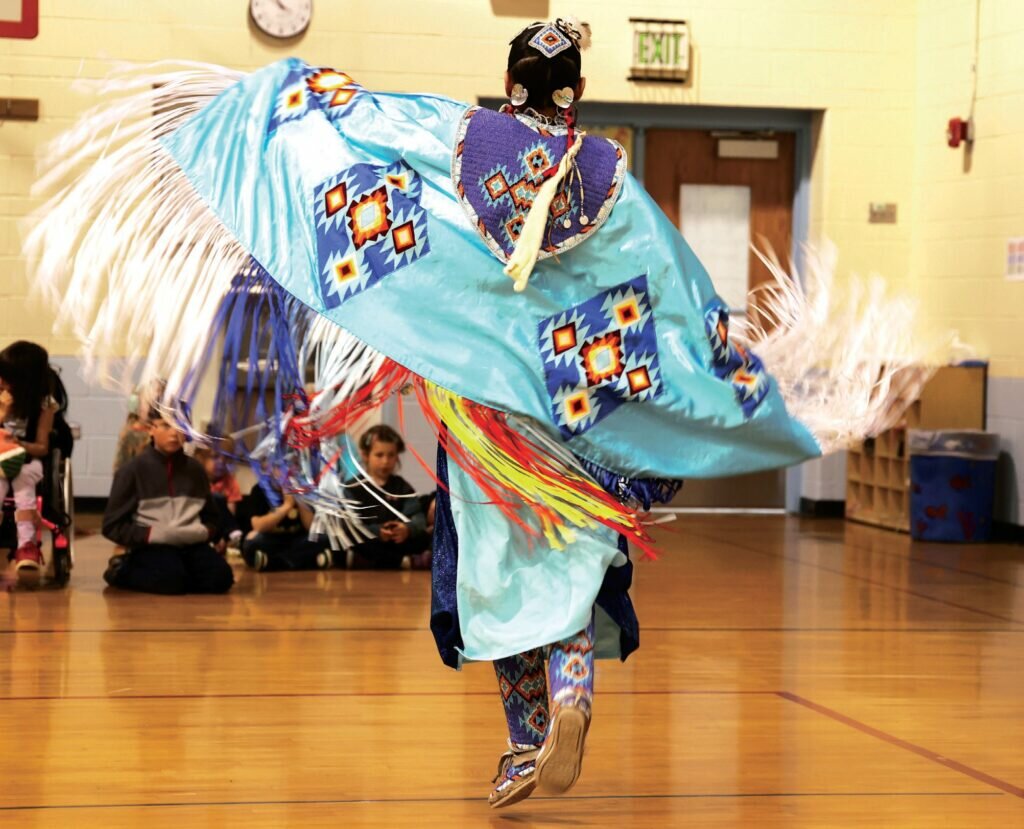
Then one of the women performed a Fancy Shawl Dance. The regalia is intricately beaded, enabling the dancer to move the shawl in a way that mimics the beauty of a butterfly. The long fringe hanging from the edge of the shawl flew in the air around the dancer. This is not merely dance; these are stories.
The Men’s Grass Dance comes from “the habit of tying braids of sweetgrass to the dancer’s belt.” This regalia weighs over 60 pounds with ribbons, beaded belt, and bells worn on the ankles.
The last dance involved everyone present. The Round Dance, or Friendship Dance, had everyone on their feet stepping in rhythm to the beat of the drum. The presenters said that the drum is like a “heartbeat of the nation.” They added, “Native Americans look at the drum as a living and breathing entity.”
This experience ended with many thanks and applause for Indigenous Corporation 5280 sharing a part of American culture that most non-Indigenous people do not know much about. Their generous and kind spirit offering to educate and spread cultural awareness is a blessing to all those who see, hear, and feel their message.
Connecting with Our Mountain Community Week at NES gave students the opportunity to look at their own heritage, the history of the Nederland area, the cultures of other people living in the Nederland area, and a look at Indigenous culture and dancing.
There is always more to learn. After a week like this, the hope is that a student’s, teacher’s, or parent’s interest will be sparked, urging them to dig a little deeper. They will research a little more, ask more questions, and open their minds to learn more.


