
Last month, we looked at a pulsating UFO from the San Luis Valley back in the 1990s, as an example of how straightforward sky objects can turn into alien spaceships when witnesses don’t have
This item is available in full to subscribers.
At this time, we ask you to confirm your subscription at www.themtnear.com, to continue accessing the only weekly paper in the Peak to Peak region to cover ALL the news you need! Simply click Confirm my subscription now!.
If you are a digital subscriber with an active, online-only subscription then you already have an account here. Just reset your password if you've not yet logged in to your account on this new site.
Otherwise, click here to view your options for subscribing.
Questions? Call us at 303-810-5409 or email info@themountainear.com.
Please log in to continue |
Last month, we looked at a pulsating UFO from the San Luis Valley back in the 1990s, as an example of how straightforward sky objects can turn into alien spaceships when witnesses don’t have binoculars. This month, we cross it off the “unexplainable” list.
To recap, this was the UFO: a brilliantly glinting point of light; visible across the San Luis Valley and northern New Mexico; low (a few degrees) above the horizon; nearly due south; clear cloudless sky; hovered motionless for a few hours; disappeared instantaneously; and recorded by a witness with an auto-focusing camcorder with a zoom-telephoto lens. The FAA (perhaps sighing?) told a local TV station that aired the “UFO tape” that nothing unusual had been spotted on radar.
I received the camcorder tape along with a note defying me to identify the object as anything earthly. In the several-minute video, the object repetitively expanded from a near point to a large, fuzzy ball, and then back into a point every few seconds. The pulsations were synchronized with a faint, varying-pitch audio whine.
Could I identify the UFO?
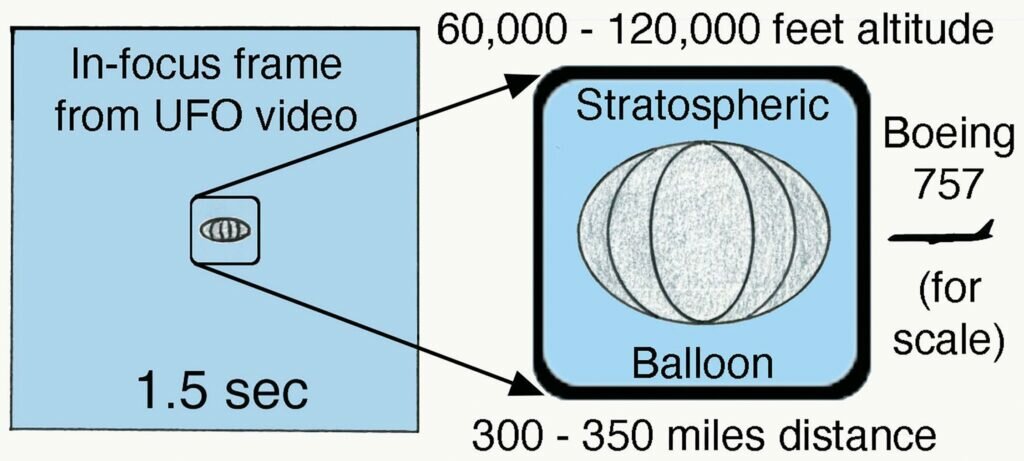
I froze the tape on a frame where the object was a near-point. There sat a very small, shimmering, oval shape with lines that ran top-to-bottom like a pumpkin’s creases. That signature instantly gave it away: It was clearly a balloon, the kind that flies between 60,000 to 120,000 feet altitude for research projects. (By comparison, commercial airliners fly at 30,000 feet.) Research balloons are oblate at high altitude. Built from tapered gores, like in a classroom globe, they have pumpkin-like top-to-bottom lines.
Everything else fell into place.
The camcorder’s auto-focus sensor had nothing to focus on, the sky being clear and the balloon being too small in the sky to trigger it. The lens’s whining motor drive “hunted” for a focus. It racked in and out, from infinity to a few feet and then back to infinity, endlessly. The balloon was always out of focus except for when the lens momentarily hit infinity every few seconds. The UFO’s “pulsations” were an artifact of the frustrated focusing.
The balloon’s extreme altitude made it visible over a large area. It glinted brightly because of the afternoon’s low sun angle. It hovered because winds aloft were minimal. It vanished suddenly because that’s how those missions terminate: The payload (a satellite instrument under test, for example) is separated and falls under a parachute, while the gas bag, bigger than a commercial airliner, is rapidly deflated and plunges, invisible, to earth.
The UFO’s low horizon angle, at due south, made me think of Holloman AFB near White Sands in southern New Mexico, some 300 miles from the San Luis Valley. I rang the base’s Flight Operations number and asked if they had flown a research balloon on the afternoon in question. The on-duty person there checked a clipboard and confirmed a flight.
And radars? They showed nothing because a 100,000 feet balloon above Holloman would have had the wrong geometry to register on that area’s FAA radar, at Albuquerque.
Another beautiful UFO, slain by ugly analysis.
Backyard Astronomy Talk Series: This correspondent’s next talk, The Amazing & Expanding (and Accelerating) Universe That Nobody Saw Coming, will be at the Nederland Community Library at 7 p.m. on November 1. Details and free registration at https://nederland. colibraries.org/backyard-astronomy/.
In October Skies: Don’t miss Nederland’s near-total solar eclipse. On Saturday October 14, a neartotal solar eclipse will be visible in Nederland between 9:14 a.m. and noon. The maximum, when the sun will be reduced to a very thin crescent, 80 percent covered, will occur at 10:36 a.m. The nearest place to see the full eclipse will be Four Corners. Viewing instructions are at: https://science. nasa.gov/eclipses/safety/.
The sun begins the month in Virgo, entering Libra on October 30. At mid-month, days and nights are 10.5 and 13.5 hours long, respectively.
The moon’s dates are: Last Quarter October 6; New October 14; First Quarter October 21; Full (Hunter’s Moon) October 28.
October Meteors: Camelopardalids October 6; Draconids, southern Taurids and delta Aurigids October 9-11; epsilon Geminids October 18; Orionids October 22; and Leonis Monorids October 25.
Best Sky Viewing Nights (Minimal Moon): October 6-20.
Sunset (Mid-Month): Pegasus is low in the east; the Navigator’s Triangle of Vega, Deneb and Altair is high overhead; and Arcturus is setting in the west.
Midnight (Mid-Month): Capella is high in the northeast in Auriga. Just above it is brilliant Perseus with Algol. Andromeda is directly overhead. Cetus, the Whale, is in the south. Orion is rising in the east.
Sunrise (Mid-Month): Leo is high in the southeast. Orion is in the southwest. Sirius, in Canis Major, is low in the south.
Mercury is lost in the sun.
Venus is the Morning Star, low in the east before sunrise.
Mars is lost in the sun.
Jupiter, in the Ram, is nearing opposition. It rises at 7:20 p.m., is high in the south at midnight, and in the southwest at sunrise.
Saturn, in the Southern Fish, is high in the south-southeast sunset, and sets at 3 a.m.
Notable Space Missions: An asteroid-rendezvous mission, Psyche, will launch on a SpaceX Falcon Heavy from Cape Canaveral on October 12. Everybody is going electric, and spacecraft are no exception. Psyche will run solar-electric motors to reach Asteroid Psyche in 2029. It will orbit around the all-metal asteroid to learn whether it is part of a stripped or aborted proto-planetary core, or whether it formed some other way.
Frank Sanders, a spectrum scientist at the U.S. Department of Commerce in Boulder, takes astronomy-related inquiries at backyardastronomy1@gmail.com.


