
Our lede this month is an urgent e-mail from a reader: “My husband and I have overcome our differences on politics, religion, guns, and election denial. What we can’t get past is an argument
This item is available in full to subscribers.
At this time, we ask you to confirm your subscription at www.themtnear.com, to continue accessing the only weekly paper in the Peak to Peak region to cover ALL the news you need! Simply click Confirm my subscription now!.
If you are a digital subscriber with an active, online-only subscription then you already have an account here. Just reset your password if you've not yet logged in to your account on this new site.
Otherwise, click here to view your options for subscribing.
Questions? Call us at 303-810-5409 or email info@themountainear.com.
Please log in to continue |
Our lede this month is an urgent e-mail from a reader: “My husband and I have overcome our differences on politics, religion, guns, and election denial. What we can’t get past is an argument about the moon’s orbit. At Thanksgiving, the whole family got involved. Everyone had their own opinion. It nearly ruined the holiday when Aunt Sophie hammered Uncle Rob with a turkey leg, right at the dessert buffet!”
“Our argument is: Standing on earth, we see the moon going around us in a monthly circle. But if we were to float out in space, what would the moon’s orbit look like as the earth moves around the sun, carrying the moon with it? I say it’s interconnected loops. My husband says it’s a series of connected half-circles, going in and out around the earth. Can you settle this for us, before we file for divorce? Perplexed in Paonia.”
Dear Perplexed, I’ve forwarded your note to our resident astronomer, Luna. She’s made your question into a puzzle for our readers, and takes it from here:
“Hi, Frank. Terrific question. I’ve known PhDs in astrophysics who were stumped by this one. It comes down to, a circle in one frame of reference is NOT necessarily a circle for another observer in a different frame.”
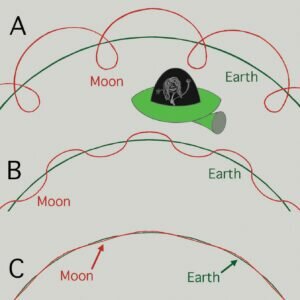
“On earth, we’re nearly at the center of the moon’s orbit. We see it moving around us in a circle. But what if we watch the moon from a place where we see the earth moving around the sun? That is, what if we follow the moon’s path through space from the sun’s point of view? Here are three possibilities, with drawings for clarity. Your readers get to pick one.”
“Possibility A is, the moon moves in a series of interconnected loops, wound twelve times around the earth’s orbit for the twelve months of the year. This is what the moons of Jupiter and other planets do. It’s what Perplexed in Paonia argues for.”
“Possibility B is a series of half-circles around the earth’s orbit. They flip back and forth, alternately outside and inside the earth’s path. They never form loops; they never go backward on themselves, like they do in Possibility A. This is what Perplexed’s husband argues for.”
“Possibility C is more subtle. Here, the moon follows its own, independent orbit around the sun. Although it swings slightly outside and inside the earth’s orbit, the moon’s path in space always bends concavely around the sun, never bending backward toward the earth at all. The moon doesn’t orbit the earth! Instead, it has its own, independent solar orbit that’s just slightly perturbed by the nearby earth.”
Which of these possibilities is correct? Re-join us in January, for the answer.
In December Skies:
The sun begins the month in Scorpius, entering Sagittarius on December 17. At the winter solstice (the shortest day and the sun’s lowest noon-point of the year) on December 21, Nederland days and nights are 9.3 and 14.7 hours long, respectively.
The moon’s dates are: Last Quarter December 5; New December 12; First Quarter December 19; Full (Cold Moon) December 26.
December Meteors: The month’s best meteor shower will be the Geminids (parent body asteroid 3200 Phaethon). It runs December 4-17, peaking on December 14. Visible from 7 p.m. until dawn, but looking best around 3 a.m.
Best Sky Viewing Nights (Minimal Moon): December 5-19.
Sunset (Mid-Month): The Pleiades rise in the east with red Aldebaran just below. Brilliant Capella rises in the northeast. The Andromeda Galaxy is high in the northeast, presenting a nice binocular view. Reddish Fomalhaut is low in the south. Deneb, Vega and Altair form the Navigator’s Triangle high in the northwest to west.
Midnight (Mid-Month): The Gemini twins Castor (above) and Pollux (below) are nearly overhead in the northeast. Orion is due south with Sirius below and to the left. M42, the Great Nebula in Orion’s sword, is visible to the naked eye; it presents a terrific view in binoculars and low-power telescopes. Taurus with the Pleiades is nearly overhead.
Sunrise (Mid-Month): Vega is low in the northeast. Reddish Arcturus is high in the east. Orangish Regulus in Leo is almost overhead, slightly offset toward the southwest. The Gemini Twins Castor and Pollux are close to setting in the west. Capella is set in the northwest.
Mercury is at its greatest elevation above the horizon, and is best seen, low in the southwest just after sunset at the beginning of the month. Look for it between December 4 to 8, from Barker Reservoir.
Venus is the Morning Star, in the southeast before sunrise. Look for its pretty conjunction with the moon just before sunrise on December 9.
Mars is lost in the sun.
Jupiter, in the Ram, is up all night and gives great viewing of itself and its moons. It will conjunct with the moon on the 22nd.
Saturn, in the Water Carrier, is in the south at sunset, setting by 10 p.m. Watch its conjunction with the moon on the 17th.
Notable Space Missions: Astrobotic’s robotic Peregine lunar lander is scheduled for launch from Cape Canaveral on a United Launch Alliance Vulcan-Centaur booster on or after December 24. Its moon landing will be in early 2024. NASA’s Juno probe, orbiting Jupiter, will make a close approach (930 miles) to the planet’s volcanic moon Io on December 30.
Frank Sanders, a spectrum scientist at the U.S. Department of Commerce in Boulder, takes astronomy-related inquiries at backyardastronomy1@gmail.com.


