
The management of forest health on private property includes controlling the spread of Dwarf Mistletoe in evergreens. This parasitic plant grows on the branches of conifers and sucks water and
This item is available in full to subscribers.
At this time, we ask you to confirm your subscription at www.themtnear.com, to continue accessing the only weekly paper in the Peak to Peak region to cover ALL the news you need! Simply click Confirm my subscription now!.
If you are a digital subscriber with an active, online-only subscription then you already have an account here. Just reset your password if you've not yet logged in to your account on this new site.
Otherwise, click here to view your options for subscribing.
Questions? Call us at 303-810-5409 or email info@themountainear.com.
Please log in to continue |
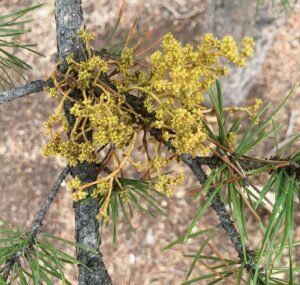
The management of forest health on private property includes controlling the spread of Dwarf Mistletoe in evergreens. This parasitic plant grows on the branches of conifers and sucks water and nutrients from the host tree. Over time the mistletoe will weaken the host tree and cause premature death. The stressed and weakened trees will also attract pine beetles, further threatening the health of the stand. Maintaining forest health on private property is a multidimensional effort that requires looking at trees for signs of infection from plants or bugs and taking appropriate action to deal with these threats.
Right now mistletoe is having a resurgence throughout Gilpin County. When the mistletoe grows from the top of the tree downward, it produces a withered crown, called a “Witches Broom.” The severity of the infection is rated based on the percentage of the tree section that has mistletoe.
If the infection is 1-50% then the rating for a section (crown/middle/bottom) is a 1. If the infection is over 50% then the rating is a 2. The middle third and bottom third of the tree are rated the same way. Combining the ratings of the three sections of the tree results in an overall score of light (2-3), medium (4-5) and severe (>5).
Controlling mistletoe depends on the severity of the infection. Light to medium infections can be treated by cutting off the branches that are showing mistletoe and disposing of the branches before the mistletoe can release their seeds. The mistletoe shoots will die as soon as the branch is cut so there isn’t any special handling required (like logs infected with pine beetles). Severely infected trees should be cut down before the mistletoe can expel their seeds, which is usually in August and September. Planting resistant or non-host trees is another option for replacing infected trees. Gilpin County’s CSU Extension Agent, Jennifer Cook, has been trained in identifying and treating diseased trees. She can be reached at 303-582-9106 or https://gilpin.extension.colostate.edu/. “Mistletoes in Colorado Conifers” is a good search term for finding more articles on the subject.
Remember this in December, when our thoughts about mistletoe tend to go in another direction entirely.


