
Elk and moose tend to “steal the show” in terms of general popularity among our greater deer family in the western United States, but there is not a more prolific and iconic animal than the
This item is available in full to subscribers.
At this time, we ask you to confirm your subscription at www.themtnear.com, to continue accessing the only weekly paper in the Peak to Peak region to cover ALL the news you need! Simply click Confirm my subscription now!.
If you are a digital subscriber with an active, online-only subscription then you already have an account here. Just reset your password if you've not yet logged in to your account on this new site.
Otherwise, click here to view your options for subscribing.
Questions? Call us at 303-810-5409 or email info@themountainear.com.
Please log in to continue |
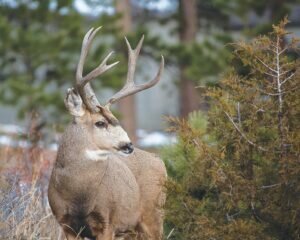
Elk and moose tend to “steal the show” in terms of general popularity among our greater deer family in the western United States, but there is not a more prolific and iconic animal than the mule deer (Odocoileus hemionus). While not the smallest of the deer family here in Colorado (the white-tail hold that claim), mule deer hold the most territorial ground in the state by a long stretch.
From the eastern plains to the alpine tundra, and further west to the canyonlands of the high desert, Colorado provides one of the best environments for the species in the U.S. and they have evolved to take advantage of every square mile they call home. All of that said, they are a species in decline.
Prior to Europeans moving into western North America, Colorado was home to an almost unbelievable population of deer and elk like the mighty bison of the plains. The gold rush brought hundreds of thousands of prospectors to the mountains with high hopes of striking it rich. While the rush was relatively short and most eventually moved further west to the easier mined gold of California, their numbers were followed by thousands more ranchers and settlers who stayed and set up permanent residence.
Whether they stayed or not, all needed to be fed, and hunting of the abundant deer and elk nearly wiped out the entire population. If not for a “last minute” recognition of the need for conservation, they would have certainly gone the route of the bison. It was estimated by Colorado Parks & Wildlife that the state’s population of mule deer at the turn of the 20th century was as low as 6,000 animals.
Conservation efforts led to a booming increase over the next 40+ years, and while numbers always fluctuate from year to year, the 50s saw the largest numbers of the 20th century at an estimate of well over one million, but it wasn’t to last. Continued human population growth, expansion of ranching and massive overgrazing by cattle, a burgeoning oil and gas industry, and mountain lands being repurposed for the growing ski industry and other human recreational purposes all helped to begin another decline as feeding grounds became overtaken.
On a more natural level, severe winters also played (and still play) havoc on the populations, sparking winter feeding programs in the early 80s. According to Colorado Parks & Wildlife, by 1989 mule deer numbers were estimated as high as 600,000 but numbers soon began to decline once again.
Colorado Parks & Wildlife estimated mule numbers in 2012 to be around 400,000 (and that may be generous), and they continue to be challenged by human expansion. It is also theorized that the growth in the elk herd numbers along with the newer addition of a now booming moose population have put more pressure on these fragile numbers.
On top of that, disease and accidental death (automobile collisions, trapping in fences, etc.) all add to this pressure and decline. On the extreme, it has also been theorized that they are at the end of their evolutionary rope and other species are simply overtaking them, but only time and more study would bring any real proof to that notion.
White-tailed deer are considered an older species, and it is theorized that mule deer came from a hybrid of white-tails and coastal black-tailed deer during the last ice age. The mule deer began to proliferate afterwards, well adapted to moving into the newly thawed territories inland. Mule deer herds do occasionally perform hybrid mating with their white-tailed cousins where populations overlap, and white-tails are also beginning to make their way back into territory traditionally left to the mule deer and elk. Just a couple years ago I was surprised to encounter a few (whitetails) in the Kawuneeche Valley on the western side of Rocky Mountain National Park, seemingly a very long distance from their typical home on the prairie.
As mentioned above, only time and more study will truly tell the direction which the species takes. I personally hold great hope that these beautiful neighbors of ours find themselves on a rebound, having been “adopted” by a local family of which the handsome buck in this week’s image is a member. I fondly remember his ancestors, and hope to get to know his grandchildren in the years to come.
Information for this article came from https://cpw.state.co.us/documents/muledeer/coloradosmuledeerstory.pdf and https://www.themeateater.com/wired-to-hunt/whitetail-management/whitetailsandmulies-a-comparison.
For additional information about James DeWalt Photography, check out https:// jamesdewaltphotography.com.


