
This week I am following up on my previous article in regard to the elk rut with a bit of “play-by-play” drama I have had the pleasure of enjoying this fall. The seasonal ritual has various
This item is available in full to subscribers.
At this time, we ask you to confirm your subscription at www.themtnear.com, to continue accessing the only weekly paper in the Peak to Peak region to cover ALL the news you need! Simply click Confirm my subscription now!.
If you are a digital subscriber with an active, online-only subscription then you already have an account here. Just reset your password if you've not yet logged in to your account on this new site.
Otherwise, click here to view your options for subscribing.
Questions? Call us at 303-810-5409 or email info@themountainear.com.
Please log in to continue |
This week I am following up on my previous article in regard to the elk rut with a bit of “play-by-play” drama I have had the pleasure of enjoying this fall. The seasonal ritual has various intricacies and strategies employed by the many players, and this year has provided quite the show. My own observations began towards the beginning of the rut in early September as I took my visiting parents up for their first ever view of the action.
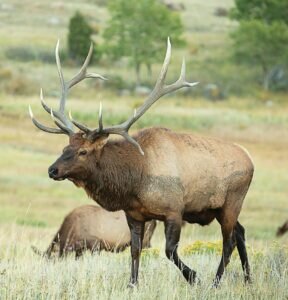
Since it was early, activity was minimal. However, we had the pleasure of watching the first harem of the valley (Moraine Park) in close proximity to the road. There were a few other satellite bulls present, but the harem of about 20 cows was being closely guarded by the handsome bull seen here. I learned that other observers have named him Kickstand, due to the noticeable drop-tine on his left antler, likely due to a bodily injury on his left flank.
On my next visit about two weeks later, I was happy to see that not only was Kickstand still present (and close-up for viewing), but he had also increased the harem by more than double. Two other herd bulls had smaller harems elsewhere, and there were a lot more satellite bulls throughout the valley. Kickstand maintained the largest group by far. I also noticed that one of the other new harems far out in the valley was being guarded by a much larger bull, who is apparently being called Atlas by some, due to his massive size, or Blade by others, due to a large, flattened tine. This made me wonder how things would play out.
The rut takes a tremendous amount of energy, with bulls expending as much as 40-50% of their stores built up over the lush summer in the high country. They don’t eat well, especially if they are a herd bull spending more time guarding their harem than they do grazing. While a bull like Kickstand might make early and large claims to cows, it is rare that the early contenders last through the full six plus week endurance challenge. More often than not they run out of steam, and when another bull makes moves to take over, they simply can’t fight anymore and lose their harem. I wondered with the size of the harem, if Kickstand would be able to hold out much longer.
Satellite bulls are always playing their own games and will often employ “group tactics” to sneak in on a harem and try their luck with the ladies. They will sometimes work together to distract the herd bull, with a couple of them calling him out for a challenge while a loner moves in among the cows. This sometimes creates an opportunity to mate, but can also split the herd with the new bull taking a number of cows to form his own harem.
A common strategy among older, more seasoned bulls is simply patience. They have played the game for a number of years and know how taxing the rut can be. They don’t expend as much energy, initially keeping only a small harem, if any at all, and their sheer prowess tends to keep the younger bulls at bay. In the case of Atlas/Blade, he was doing quite well at this tactic. I observed a few satellites trying to move in on him, but in every attempt all he had to do was prance out from the ladies to accept their challenge. All backed away immediately, not wanting to take on the massive elder and not providing nearly enough distraction for others to move in. I theorized that by the end of the season, Atlas/Blade would eventually make his move and take all of the cows as his own, regardless of mating with them.
Upon my next visit a few days later, some of my observations and theories proved true. I found Kickstand bedded down towards the back of the valley, still bugling to his heart’s content, but with only two or three cows to speak for. When I made my way to where he had kept the larger harem, I found that another bull had laid claim to about half the cows. When I looked back down the valley, another larger bull had taken the remainder for his own. Looking out across the valley I could still see Atlas/Blade maintaining his small harem and biding his time.
While all of the herd bulls have likely had at least a handful of opportunities to mate, I’ve mentioned before that it is always ultimately the cows who choose which bulls get the chance. It will be interesting to see how things play out, with the rut wrapping up about the time this article is published, and if my theory will hold in regards to Atlas/Blade being the winner swooping in at the end and taking in this great game of life.
For additional information about James DeWalt Photography, check out https://jamesdewaltphotography.com.


