
After writing the last two Life in Nature articles regarding the elk rut and the “saga” of this year’s season in Moraine Park, I thought I would wrap things up with a final article
This item is available in full to subscribers.
At this time, we ask you to confirm your subscription at www.themtnear.com, to continue accessing the only weekly paper in the Peak to Peak region to cover ALL the news you need! Simply click Confirm my subscription now!.
If you are a digital subscriber with an active, online-only subscription then you already have an account here. Just reset your password if you've not yet logged in to your account on this new site.
Otherwise, click here to view your options for subscribing.
Questions? Call us at 303-810-5409 or email info@themountainear.com.
Please log in to continue |
After writing the last two Life in Nature articles regarding the elk rut and the “saga” of this year’s season in Moraine Park, I thought I would wrap things up with a final article regarding the current state of affairs in the valley.
The last few weeks had me quite busy with capturing human memories in the way of fall family photo sessions and portraits for school. My “time in the wilds” was mostly relegated to living vicariously through other people’s photos in between photo shoots and editing. As things wound down in my own schedule, I took my first opportunity to head up and see for myself how everyone was doing.
I took a different approach on this last visit and was out of bed and in the park well before sunrise as opposed to my last few evening visits. As I arrived in the valley, there was a stillness to the 20-degree air and it was a good bit more quiet than I had anticipated. While I knew the rut was well wound down, I still expected to hear a bit more bugling. I took my usual tack heading to a less “popular” (by humans) spot to start my morning, but the only calls I heard were coming from the far side of the valley from my position.
As I made my way to the back of the valley, I happened upon one large bull pushing three cows with a bit of a frantic pace, and he was bugling a response to another bull out of sight in the middle of the valley. It was too dark to capture images, and he was heading rapidly into the forest, so I decided to try my luck with the other bull. I could see a small harem a good way out in the dim light but held hopes that I might get some photo opportunities once the sun started coming up.
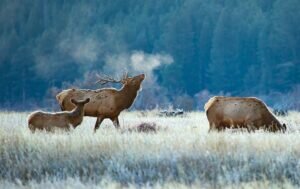
Entering the valley itself is prohibited this time of year from 5 p.m. until 10 a.m., but taking trails which skirt the valley is permitted, so I headed across the western edge in the general direction of the harem with high hopes. I could hear bugling, but as I strolled along the trail I realized it was coming from a different harem, barely visible as they were tucked into a dip in the valley floor. Upon my arrival at the harem I had seen from a distance, I was surprised to find the handsome but younger bull seen here, rounding up about a dozen cows.
As I watched, I could still hear bugles from the bull out in the valley as well as the larger bull I had encountered on my way in, but interestingly this young lad was keeping quite silent. He seemed a bit anxious, and while anxiety runs rampant during the rut, this bull gave more of an impression of skittishness than the anxiety that comes from testosterone overdrive and unrequited sexual tension. At one point he even left the harem completely and trotted off into the heart of the valley as though giving them up altogether. He did return about 10 minutes later, but the behavior was not that of a bull steadfastly defending his harem.
I spent the next 45 or so minutes with them as the sun began its climb before I decided to enjoy breakfast in the warmth of my car. As I took my meal, I was thinking about this odd yet beautiful morning encounter, and as I pondered, the “story” began to play out (in theory) in my mind. My guess is that this bull had been paired up with the larger bull I had encountered during my pre-dawn entry, and both had decided to stage a raid on the larger harem that remained out of my sight. I had missed the actual raid by about 10 or 20 minutes, and this is likely why the first bull I’d encountered seemed to be frantically pushing his three cows into the forest and away from the likely larger herd bull.
This theory would also explain the odd behavior of the bull I’d spent time with, as well as his silence. He had succeeded in peeling off a larger share of the harem but didn’t have the will to push them further from the larger bull. He found himself in the precarious position of wanting to have his own (likely first ever) harem but refrained from bugling his own responses so as not to arouse the attention and ire of a bull he knew well he would never win against in a battle. He desperately wanted to show his prowess to his new-found treasure, but they mostly ignored him and thus he pranced about with unease and even ran away. I did come across the harem again about an hour or so later, and it seemed as though he gave up completely and left them, as they were making their own way into the forest without him.
As to our friend Kickstand I have been writing about, he finally left the field of battle a few days after my last encounter with him. I had the pleasure of watching a video captured by another photographer who had spent far more time in the valley than I and had been following and reporting on Kickstand’s progress throughout the rut. I enjoyed a video the gentleman posted of his final retreat, a slight limp in his step, yet head held high.
In this last visit I also saw “Blade,” still out in the middle holding his ground with the same small harem, but they too were slowly heading towards the forest and it felt like all of the actors were leaving the stage and retiring to the winter home, wrapping up another amazing season in the valley of kings.
For additional information about James DeWalt Photography, check out https://jamesdewaltphotography.com.


