
With winter winding its way into spring, initially I had planned on writing this article with the challenge of seeing who might capture the first glimpse of one of the earliest signs of spring we
This item is available in full to subscribers.
At this time, we ask you to confirm your subscription at www.themtnear.com, to continue accessing the only weekly paper in the Peak to Peak region to cover ALL the news you need! Simply click Confirm my subscription now!.
If you are a digital subscriber with an active, online-only subscription then you already have an account here. Just reset your password if you've not yet logged in to your account on this new site.
Otherwise, click here to view your options for subscribing.
Questions? Call us at 303-810-5409 or email info@themountainear.com.
Please log in to continue |
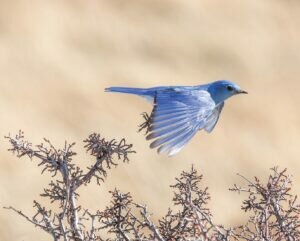
With winter winding its way into spring, initially I had planned on writing this article with the challenge of seeing who might capture the first glimpse of one of the earliest signs of spring we see locally: the annual return of our beautiful cerulean summer neighbors, the Mountain Bluebird. Alas, during a late-winter escape to visit my parents in Florida, the first was already spotted, noted on March 3 in the Facebook group Nederland Area Nature.
These visually striking creatures tend to be easily spotted, as their brilliant plumage provides a sharp contrast as they flit about the still-white blankets of snow. The male, as with most bird species, has the more brilliant coat, typically all blue, while the female is mostly brown with a blue rump and wings.
Even after the snow melts, the intensity of blue that graces both sexes is unmistakable among the lingering brown and gold of tall grasses yet to be flush with the green of summer.
Mountain Bluebirds tend to live in or around meadows, especially if the meadow is next to their favorite nesting trees, aspens. We certainly have an abundance of both, so these birds can be a common sight – perching on a low shrub, fence post, or wire as one passes along our country roads.
They prefer aspens for nesting because there are frequently ample holes in their dead trunks. If you happen to live in or near these aspen-adjacent meadows, you can also encourage bluebirds to move in by providing bird boxes, which are easily constructed or purchased.
It is best to have a box up before they arrive, but it is never too late (or early) to try, and you may still end up with a happy resident, even if it’s some other bird.
If you are interested in attracting the species, here are a few tips that naturalists have discovered regarding the placement of the boxes. It is ideal to provide a pair of boxes, spaced about 20 feet apart, to accommodate competitive species. Competition for nesting can be fierce as migratory neighbors return, so it helps if you can shelter more than one species – the bluebirds’ major competitors for boxes are swallows – even if your heart is set on bluebirds.
Make sure the entrance hole faces away from prevailing winds, and, if near a road, faces away from the road. Bluebirds do not tend to nest high in the treetops, so it is best to keep the box within a few feet of the ground. Fence posts are ideal.
Their main food source is insects, which they hunt from perches on fences or atop smaller shrubs, so it is also recommended that you sit your boxes close by.
It also bears noting that when it comes to partnership, the female of the species prefers an ideal nesting site over a brilliant coat or sweet song of a male. So providing a solid home is a great way to help a guy out (and land you a beautiful pair to ornament your property during the summer).
The male will scout out a location, but it is the female who ultimately makes the decision on the nesting site and does the actual nest-building. A successfully mated pair will produce one or two broods of four to eight eggs per clutch each summer. The eggs will be incubated by the female for about two weeks.
Once hatched, the babies will stay in the nest for about three weeks before fledging. When fledged, the birds will form a flock with one or both broods. With the addition of non-breeding birds, they will come and go from the nesting area for the remainder of the summer.
Best of luck to you if you attempt setting up nesting boxes! It can take some patience to see results, as it sometimes takes a few years from setting a box up to hosting a family. But if you are successful, this is a gratifying addition to your home regardless of species. If you are graced with the pleasure of calling these brilliant winged delights your neighbors, enjoy hosting one of the most beautiful passerine birds of the American west!
Additional information for this article came from https://www.allaboutbirds.org/guide/Mountain_ Bluebird/lifehistory.
For information about James DeWalt Photography, check out https:// jamesdewaltphotography.com.


