
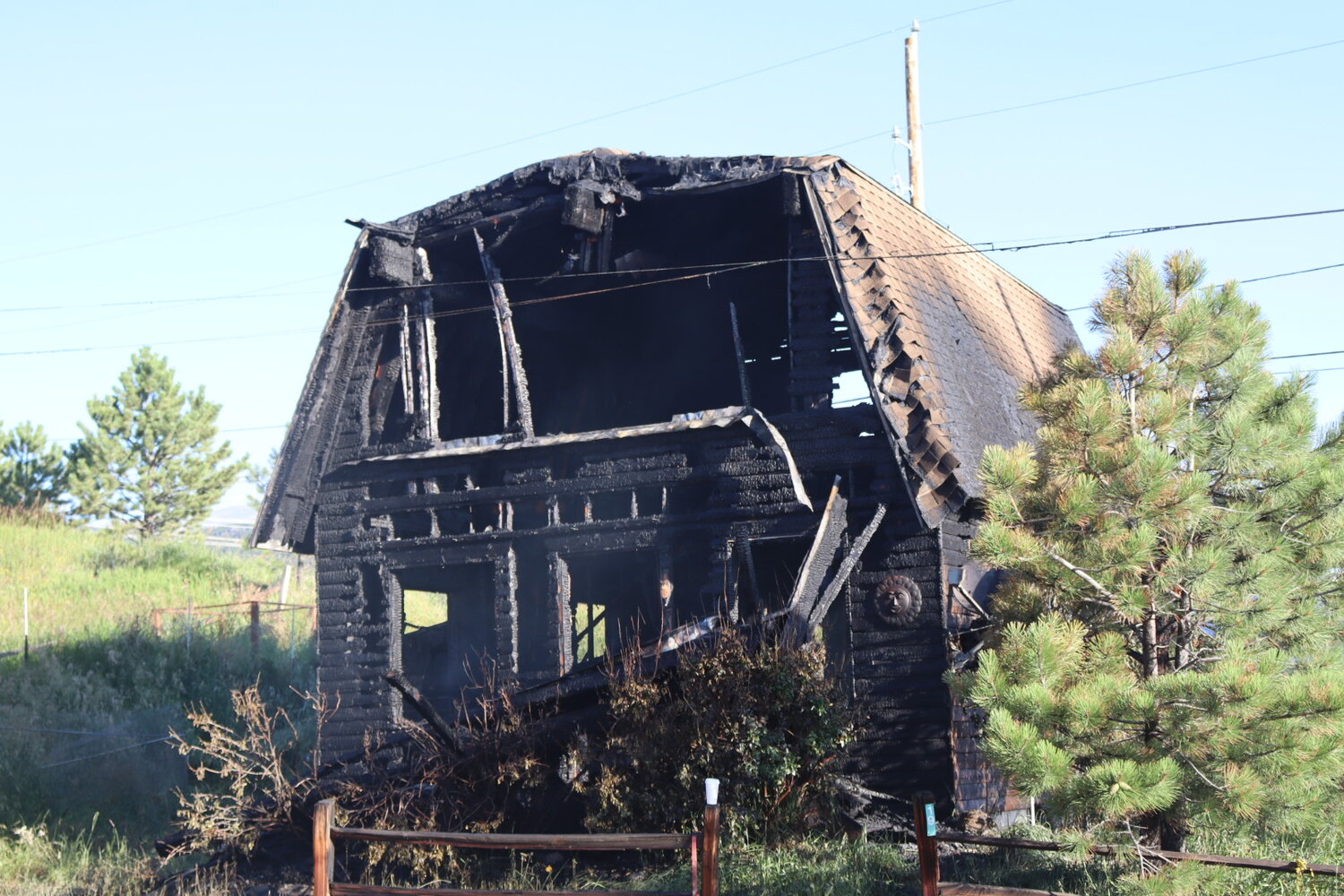
On August 8, 2023, at 2 a.m., the two-story house at the entrance to Wolf Tongue Court was on fire. Though the house was destroyed, Nederland firefighters extinguished the blaze before it could spread to any neighboring structures, including High...
This item is available in full to subscribers.
At this time, we ask you to confirm your subscription at www.themtnear.com, to continue accessing the only weekly paper in the Peak to Peak region to cover ALL the news you need! Simply click Confirm my subscription now!.
If you are a digital subscriber with an active, online-only subscription then you already have an account here. Just reset your password if you've not yet logged in to your account on this new site.
Otherwise, click here to view your options for subscribing.
Questions? Call us at 303-810-5409 or email info@themountainear.com.
Please log in to continue |
An unfortunate event
The house was unable to survive the fire of August 8, 2023, but luckily neighboring properties were unharmed.

Clearing an eyesore
The Town of Nederland placed a court order dictating that the destroyed property be cleaned up.

Help from a local
Local resident and business owner Jesse Seavers took matters into his own hands to clear the area, and hopes to develop it into a future commercial opportunity.


NEDERLAND - On August 8, 2023, at 2 a.m., the two-story house at the entrance to Wolf Tongue Court caught fire. Though the house was destroyed, Nederland firefighters extinguished the blaze before it could spread to any neighboring structures, including High Performance Earthworks (HPE) right across the street, or the historic mill just a few feet down the road.
One year later, the burnt husk of the house still stood on the property at 19 West 1st Street.
On June 4, 2024, Jesse Seavers, Nederland resident and owner of HPE, proposed to the Board of Trustees (BOT) that he purchase the land to clear the destroyed home and build new housing.
Back in 2023, the Town of Nederland had committed to a controlling program of the State Affordable Housing Fund, Proposition 123, which provides municipalities with access to funding for affordable housing projects. The Town committed to provide 14 affordable housing units by November, 2026.
Unfortunately, because the single-family home at 19 West 1st Street had been a non-conforming use for an Industrial-zoned lot, and because the home was not restored within six months, as stipulated by Nederland Municipal Code (NMC) 16-185, housing is currently not permitted on the lot.
At that BOT meeting, Seavers requested the BOT remove or amend the timeline stated in NMC 16-185, and change the Use Group Table within NMC 16-32 to allow residential uses in Industrial zones. He also spoke of maximizing the potential of the Wolf Tongue Mill industrial area by allowing more land uses.
“We’re open to doing anything,” Seavers said in a recent interview with The Mountain-Ear. “We’re trying to help the situation here. We got tired of staring at a burned-down building as much as the next person.”
As the matter involved NMC Chapter 16, it was moved to the Planning Commission, who discussed on June 26, 2024 the matter of changing the Use Group Table. The focus of the conversation quickly became that of potentially rezoning all four parcels within Nederland’s Industrial area that have residential properties on them.
It was suggested that Commissioners should continue the discussion with members of SE Group, the third-party firm hired by the Town to draft its Comprehensive Plan update.
One month later, representatives from SE Group offered their analysis of Nederland’s entire Industrial zone, which includes the Wolf Tongue Mill and five properties currently operating as non-conforming residential use.
They stated their belief that the area was underutilized, and that some rezoning could be considered appropriate. Town Administrator Jonathan Cain added that industrial zones create opportunities for the operation of distilleries and recreation-related businesses.
SE Group agreed to include language within the Comprehensive Plan stating the Town’s interest in further exploring changes in the uses allowed on Industrial-zoned land.
“This is prime property, right next to the RTD lot, that the Town should want to develop for a tax base,” said Cameron Beebe, an HPE employee, in an interview with The Mountain-Ear. “There’s a lot that can be done here.”
Meanwhile, the discussion among Town officials regarding Seavers’ initial proposal regarding 19 West 1st Street veered more toward removing allowable uses from the Use Group Table for industrial-zoned properties, particularly those pertaining to mining and milling.
By November 20, 2024, the Planning Commission had recommended the Town staff-drafted ordinance to the BOT.
Ordinance 869, which amends the Use Group Table within NMC Chapter 16 to prohibit mining and milling on property zoned as Industrial, was approved by the BOT on December 17.
As to what other potential uses were being considered as allowable on Industrial-zoned property—related primarily to affordable housing development—Cain and Community Planner Britt DeMinck specified that the Planning Commission audit NMC in 2025 regarding land use once the Comprehensive Plan is completed.
Seavers was contacted by the owner of 19 West 1st Street regarding the Town’s order to clear the wreckage of the house that once stood there.
“Since I already had it under contract previously, it was natural to discuss me purchasing it and taking care of the expense of the disposal on my own.”
Though Seavers did not have an immediate plan for the land, he knew his options were somewhat limited as housing was not permitted and the 4,000 square foot parcel was half of the minimum lot size required for an industrial zone.
“I figured we could do a complementary business for what we’re doing here,” Seavers said, sitting within the HPE warehouse, noting that he involved his staff in an after-hours discussion about the possibilities of the property across the street.
“We’ve been trying to figure out how we want to partner. We’re practicing a dynamic equity model, which allows for us all to contribute different amounts and have it still be fair and equitable,” Seavers explained.
A dynamic equity partnership is the model often used by tech startups, where in lieu of a large financial contribution, time and “sweat equity” are considered worthy and equal investments into the endeavor.
“It incentivizes partnership, because so many times there’s a very high barrier for equity or ownership in a company,” Beebe said. He was one of the first to partner with Seavers.
For Beebe, the partnership represents coming out of the ivory-tower world of academia to establish himself in Nederland’s community, and, with time, sweat, and some money, invest in a venture that best carries him, and the community, forward.
“The winds are behind us. People want to see development up here!” Beebe exclaimed.
“And we have an interest in improving the Town and trying not to go broke while doing it,” Seavers said.
“I have a real interest in innovative business models, because business models and partnership models should be advancing as much as everything else. I see this as an opportunity for us to prototype a really robust partnership model that could go along with our spirit of innovation.”
Currently, Seavers and Beebe are working with the Town on finding any preexisting variances granted for 19 West 1st Street, or a preexisting letter approving nonconformity.
Seavers and Beebe envision this venture as ushering in commercial development for a neglected part of Nederland, and not just for West 1st Street. They hope that whatever business that they place on that land can serve as a gateway to the potential of Wolf Tongue Court.
“The best idea so far is, we can stack shipping containers, do a catwalk and some metal stairs that connect them all, and have seven or eight different business opportunities,” Seavers said, mentioning personal contacts who design and outfit shipping containers as commercial kitchens.
“So you can drop it on site and you have a pop-up restaurant right then and there. We can have a two-year lease period where you prove your business model and then you move out,” Seavers explained.
“It’s a business incubator,” Beebe elaborated.
NMC Section 16-32 states that the following uses in Industrial zones are permitted by a special review process: contracting yards; transportation centers; personal storage facilities; wind turbines; solar energy systems; the warehousing, manufacturing, fabrication, processing, and assembly of products; salvage yards; impound lots; and research facilities.
The pace of Nederland’s governmental process is often not on track with those with the ambition and means to propose change. The Town, in instituting these strategic and comprehensive plans, are hopefully paving the road ahead so the next Trustees and Commissioners can match the pace of progress.


