
As I work in my home office, I take a moment to look outside. It’s mostly sunny and reaching the low 50s. I open my front door to let some fresh air in with the knowledge that in a couple of
This item is available in full to subscribers.
At this time, we ask you to confirm your subscription at www.themtnear.com, to continue accessing the only weekly paper in the Peak to Peak region to cover ALL the news you need! Simply click Confirm my subscription now!.
If you are a digital subscriber with an active, online-only subscription then you already have an account here. Just reset your password if you've not yet logged in to your account on this new site.
Otherwise, click here to view your options for subscribing.
Questions? Call us at 303-810-5409 or email info@themountainear.com.
Please log in to continue |


As I work in my home office, I take a moment to look outside. It’s mostly sunny and reaching the low 50s. I open my front door to let some fresh air in with the knowledge that in a couple of days, the beautiful weather will remind me of where I live.
Though I enjoy snow, even shoveling it, I think I’m ready for warmer days. I crave the sound of Rocky Mountain earth beneath my hiking boots at 5 a.m. I looked through my photo library and traveled back to 2023, finding myself in Colorado Springs at the end of September.
I decided to head southwest to show a friend one of my favorite Colorado Springs spots, North Cheyenne Cañon Park. The park is home to the beautiful Helen Hunt Falls and 1,600 acres of pristine wilderness.
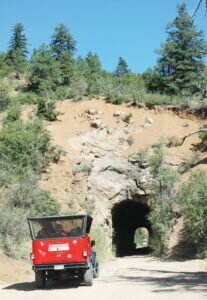
One of the park’s main attractions is Gold Camp Road, connecting Colorado Springs with the mining towns of Victor and Cripple Creek. Aside from the breathtaking scenery on the south side of Pikes Peak, the road is home to historical landmark tunnels.
During the Pikes Peak Gold Rush of the late 1850s, the tunnels provided a connection between Cripple Creek and Colorado Springs. By 1901, the Short Line train service, with 200 freight cars, was hauling supplies and people throughout the area.
With the laying of the railway, tunnels were carved out of the mountain to provide access for workers and travelers. Legend has it that there were originally nine tunnels, many of which have collapsed.
The Short Line railroad was sold in 1922 and converted into the Corley Mountain Highway, which opened in 1924 as a toll road for cars, allowing them to drive through the tunnels.
Just before the spring of May 1939, the route became a public road and remained open until 1988, when a portion of tunnel #3 collapsed. Rumor has it that a school bus ran into the tunnel, killing everyone on board.
Interestingly, the only information found about the alleged crash is the numerous variations of the incident. Today, three tunnels remain on Gold Camp Road, with Tunnel #3 inaccessible to cars or people.
Visitors have reported hearing laughter, seeing tiny handprints on foggy windows, tugging on their clothes, and finding scratches on their skin without an explanation. Others claim to feel people pushing against their car and seeing apparitions of a man.
With a vivid imagination, I wonder if the paranormal was active while I was there. I didn’t experience anything, but it doesn’t mean it isn’t real. After all, life has taught me that anything is possible, including warm days in March.
Gold Camp Road is located within North Cheyenne Cañon Park and Pike National Forest. To learn more about the Gold Camp Road tunnels, visit https://www.dangerousroads.org/northamerica/usa/1175-gold-camp-road-usa.html.


