
Top officials from the City of Boulder and the University of Colorado met last week for their annual discussion of shared concerns and issues.
This item is available in full to subscribers.
At this time, we ask you to confirm your subscription at www.themtnear.com, to continue accessing the only weekly paper in the Peak to Peak region to cover ALL the news you need! Simply click Confirm my subscription now!.
If you are a digital subscriber with an active, online-only subscription then you already have an account here. Just reset your password if you've not yet logged in to your account on this new site.
Otherwise, click here to view your options for subscribing.
Questions? Call us at 303-810-5409 or email info@themountainear.com.
Please log in to continue |

CU Boulder plans to add nearly 2,000 units of housing in the coming years to address the region's housing shortage, officials said in a recent meeting with Boulder City Council.
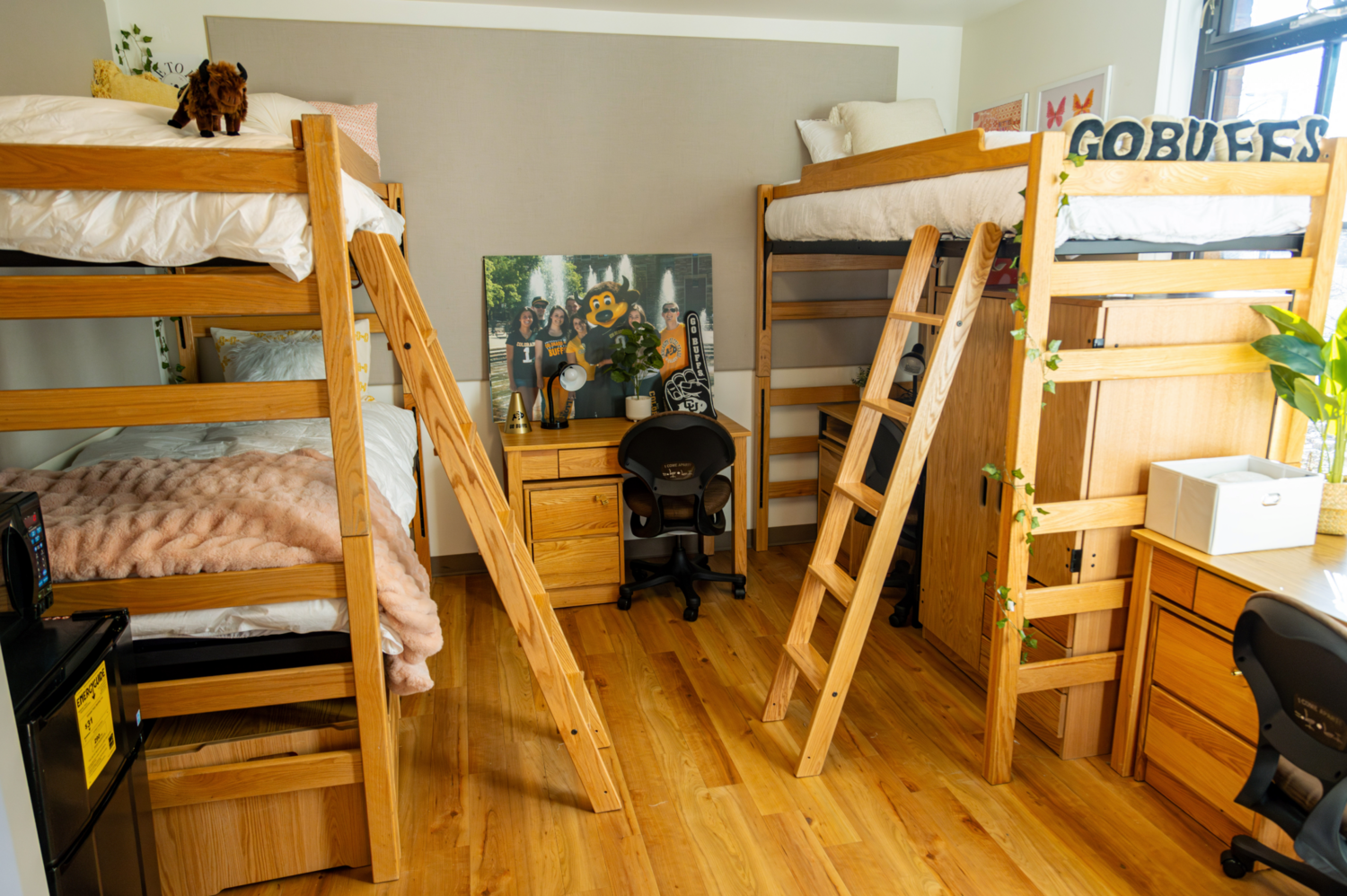
A dormitory at Farrand Hall, which next year will undergo a renovation that will temporarily take 385 beds offline at the University of Colorado.


BOULDER — Top officials from the City of Boulder and the University of Colorado met last week for their annual discussion of shared concerns and issues. Top of mind was housing; namely, CU’s need to provide more homes for its growing student body.
CU has added 3,800 students since 2020, 3,500 of whom were undergrads. More than 38,800 people attended the university in Boulder for the fall 2025 semester, including 32,500 people pursuing undergraduate degrees.
Yet CU provides housing for fewer than 10,000 students, including graduates and undergrads, leaving thousands of Buffs—plus the thousands more faculty, staff and workers needed to support them—to compete with other Boulderites on the open market for some place to live.
The pressure of the student body on the local housing market has long been a source of tension between the city and university—a conflict made clear by a pointed and direct question from Boulder City Councilman Mark Wallach.
“That’s a very impressive description of additional housing,” Wallach said following a presentation of the university’s plans. “How is the growth of your housing compared to the growth of your student body?”
“The short answer is we’ve not kept pace with it,” said Amy Hutton, Vice Chancellor for Enrollment Management, “so we’ve been pushing those students out in the community.”
To begin addressing the imbalance, CU is planning for thousands of additional units. In the works are 1,982 beds set to be added by 2028, with the potential for thousands more in the long-term. Plans include the 332-bed Code Talker Hall, which should open in fall 2026 and a 1,650-student project at Colorado Avenue and Regent Drive, the first phase of which has an estimated 2028 opening date.
Looking further into the future, the buildout of a southern campus on land recently annexed into the City of Boulder could eventually house up to 1,100 students, faculty or staff. The former Cinebarre in Louisville will add an unknown number of units as well; early-stage plans are expected sometime this month.
“This is a first step,” Hutton said, “a small step.”
d'Andre Willis, Assistant Vice Chancellor for Planning & Design, also pointed to the hundreds of units planned by private developers within a short distance of the university. That includes 300 dwellings at the former site of the Millennium Harvest Hotel at Arapahoe and 28th, as well as the recently approved 427-unit redevelopment near Williams Village on the site of Boulder’s beloved Dark Horse Bar and Grill.
The construction boom comes as CU shifts focus from recruiting to retention, university officials said. University enrollment grew by about 1% in 2025, Hutton said, “much smaller than we saw the last couple of years.”
“We’re not looking for a big increase at the graduate and masters levels [and] we have been very intentional in reducing our first-year class,” she added, from a high of 7,500 to around 7,400 this year. “That smaller first-year class is where we’re planning to stay. Any growth would come from our retention.”
The school saw record retention and graduation rates in the spring, with the latter surpassing 60% for the first time in school history.
“While we are seeing growth through retention,” Hutton concluded, “ultimately we’ll see these students graduate faster, which is why we’re here.”
Providing more housing is part of that.
“What we know is, first and foremost, students are more likely to be retained or graduate if they live on campus or close to campus,” said D’Andra Mull, Vice Chancellor for Student Life. “They tend to come back, they tend to give back.”
No land back for now
Officials also discussed Tribal relations and sustainability. In 2023, CU created a new position for a liaison between the university and Colorado’s Native American communities.
The reception to the work has been positive among the Tribes, according to Benny Shendo, Jr., Associate Vice Chancellor for Native American Affairs.
Boulder City Councilwoman Taishya Adams asked if the university was considering any “land back” agreements. The movement includes recognition and, sometimes, return of or payment for land occupied by Tribes before colonization.
Shendo said. “At this moment, I’m not aware” of any land back movements, and added "I haven’t been in any discussions around that.”
Boulder and the university sit on land that was once home to the Arapaho, Cheyenne, Ute, and other tribes. A land acknowledgement was adopted by CU in 2020.


