
Legend has it that the noxious plant Oxeye Daisy was introduced to the Moffat Tunnel region by a wedding party that had brought bouquets of flowers to an outdoor wedding. It didn’t take long
This item is available in full to subscribers.
At this time, we ask you to confirm your subscription at www.themtnear.com, to continue accessing the only weekly paper in the Peak to Peak region to cover ALL the news you need! Simply click Confirm my subscription now!.
If you are a digital subscriber with an active, online-only subscription then you already have an account here. Just reset your password if you've not yet logged in to your account on this new site.
Otherwise, click here to view your options for subscribing.
Questions? Call us at 303-810-5409 or email info@themountainear.com.
Please log in to continue |
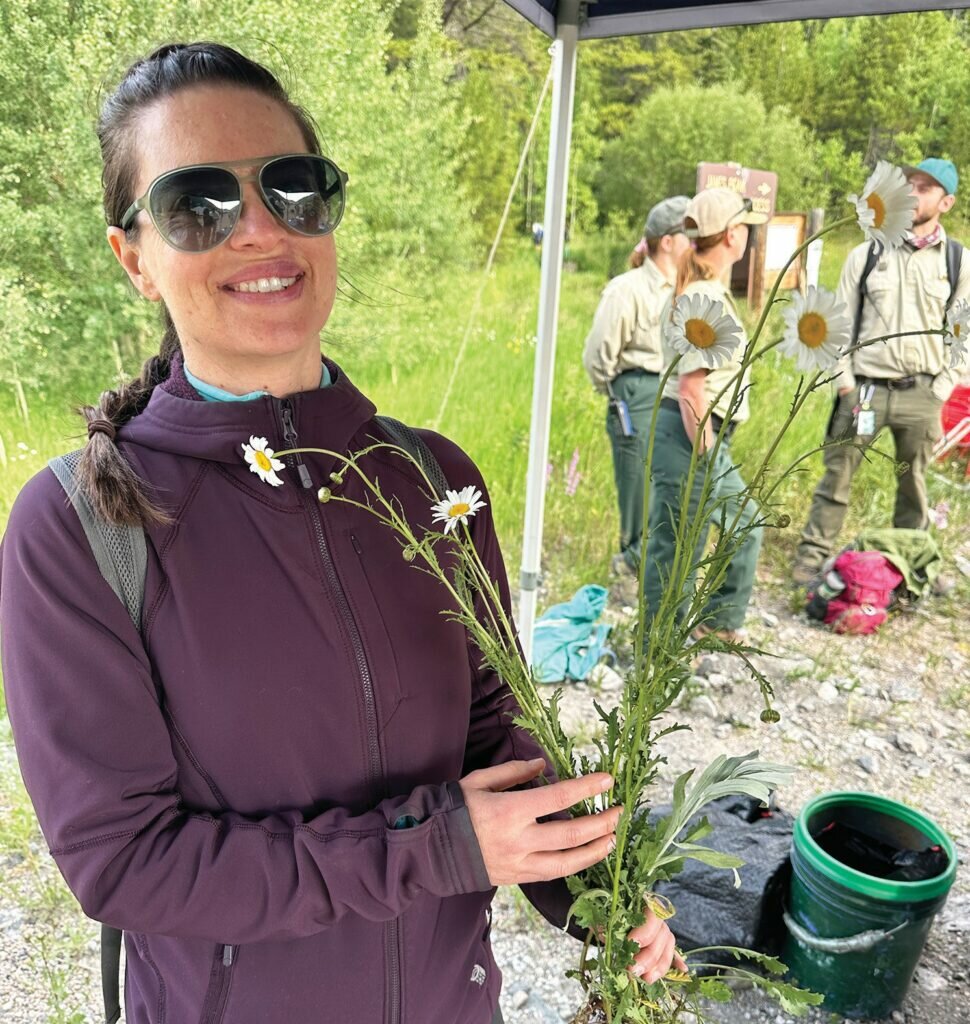


Legend has it that the noxious plant Oxeye Daisy was introduced to the Moffat Tunnel region by a wedding party that had brought bouquets of flowers to an outdoor wedding. It didn’t take long before the plants took root from the discarded bouquets, and soon the meadows near the tunnel trailhead were being overwhelmed by them.
Twenty years ago, Gilpin County CSU Extension Agent Irene Shonle teamed up with the non-profit organization Volunteers for Outdoor Colorado (VOC) and the National Forest Service (NFS) to try to keep this noxious plant from invading the James Peak Wilderness. They organized a volunteer workday to pick Oxeye Daisies at the Moffat Tunnel trailhead.
On Friday, July 26, 2024, another team of 30 volunteers assembled at the Moffat Tunnel trailhead to continue the effort to control the spread of this invasive species and protect the native wildflowers in the wilderness area. There were volunteers in the group who were at the first weed pull in 2004, along with Gilpin County residents and newcomers to Colorado.
Volunteers for Outdoor Colorado was established in 1984 to provide a volunteer workforce for outdoor stewardship projects. The goal was to enable people to become active stewards of Colorado’s natural resources. VOC organizes events and provides leadership for a range of activities including trail maintenance and construction, fire mitigation, habitat restoration, and urban gardening.
VOC Project Leader Anna Zawisza said that the organization has about 3,500 volunteers and is gaining members again after the pandemic. The weed pull is scheduled for late July when the flowers are out but haven’t yet gone to seed. One plant can produce up to 26,000 seeds over a multi-year life cycle.
The volunteers were divided into three crews, each assigned to a different area around the trailhead to pick and bag the flowers and buds and then pull the plant since it is a perennial (multi-year) plant. The flowers and buds were put in 5-gallon buckets for disposal and the plant stems were left to decompose.
The volunteers performed over 100 hours of work for the project, which NFS Ranger Amy Britwistle said was of immense help in controlling the spread of noxious plants. She is the only full-time ranger dealing with noxious plants in the Arapaho and Roosevelt National Forests, and usually has a summer crew of about three to deal with 1.5 million acres of public lands.
Gilpin County CSU Extension Agent Jennifer Cook was grateful for the turnout and said that these projects really are making a difference. Twenty years ago, some of the meadows near the trailhead were completely covered with daisies. This year those same meadows just had clumps, which the volunteers were able to completely pick and bag.
Oxeye Daisy is still commonly sold in wildflower seed mixes, so avoid any mixes that include leucanthemum vulgare.
Volunteers for Outdoor Colorado (voc.org; 303-715-1010) are always recruiting people who enjoy the outdoors and want to give back to help with the stewardship of Colorado’s natural resources. For more information on controlling noxious plants in Gilpin County, contact Jennifer Cook (303- 582-9106; Jennifer.Cook@colostate.edu) or visit their website (gilpin.extension.colostate.edu/programs/natu/noxious-weeds).


